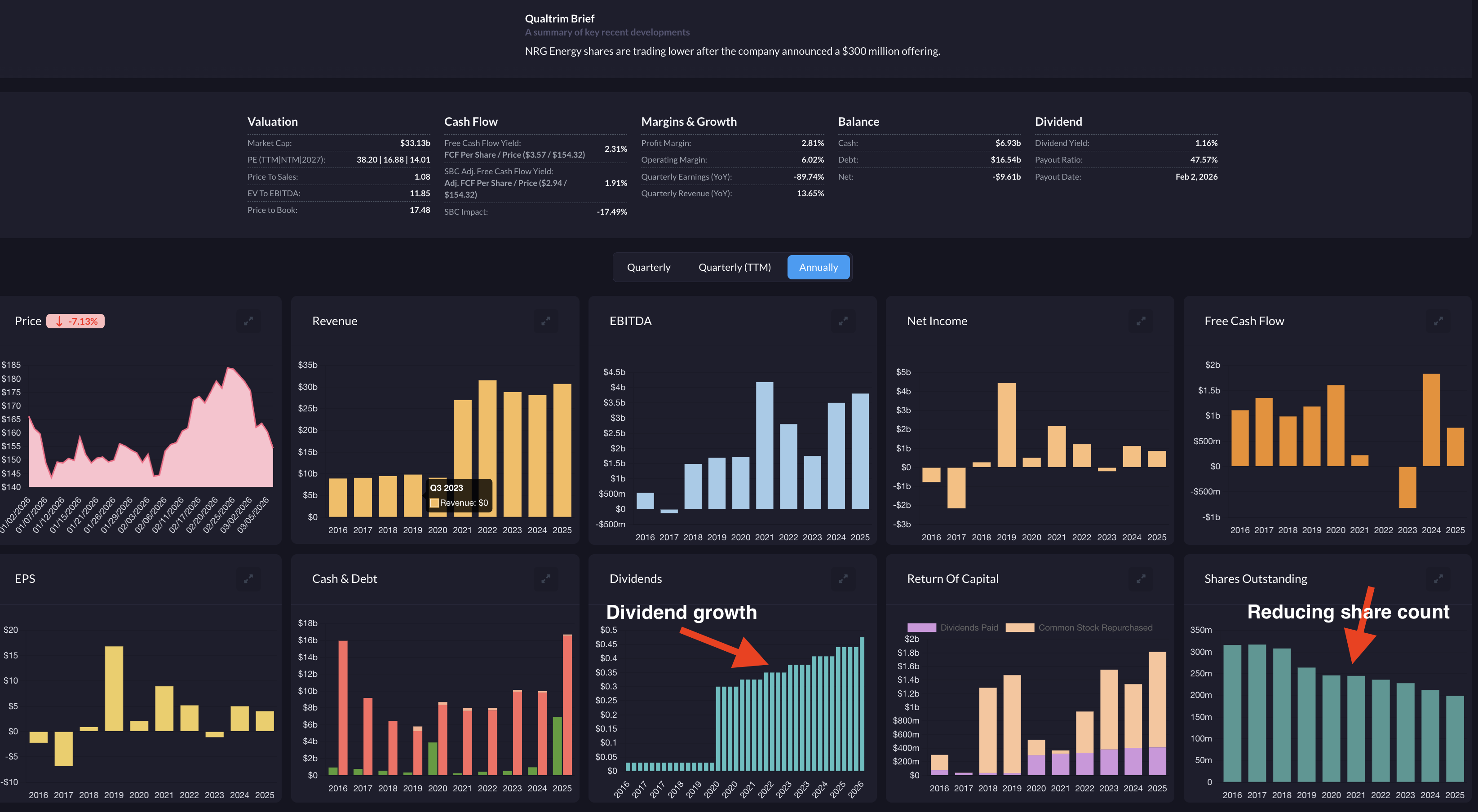
NRG sells electricity and home services to roughly 8 million customers under brands like Reliant and Green Mountain Energy, and owns about 25 gigawatts of power plants after doubling its fleet in early 2026. In August it announced a 1.2 gigawatt power project for a major cloud and AI company, and the stock fell 15% that same day.
Catalysts
The 1.2 gigawatt project reaching a final go-ahead decision. Announced August 4 with disclosed economics: $3.2 billion to build, expected to generate $500 million of annual operating profit and $375 million of spare cash once running, a return target of 12 to 15%, and a term of at least fifteen years. It could later expand to 2.4 gigawatts. The crucial detail is that 95% of the cash flow comes from fixed availability payments that begin the day the plant starts, regardless of how much power the data centre actually consumes.
Turbine and construction capacity already locked up. NRG has secured 5.4 gigawatts of gas turbine slots and construction capacity through 2032 via a joint venture with GE Vernova and Kiewit. Turbines are currently in global short supply, so holding delivery slots is itself an advantage competitors cannot quickly copy.
Rising capacity payments in the eastern grid region. NRG collects fixed payments simply for being available to supply power when demand peaks: roughly $644 million in 2026 rising to $729 million in 2027. One caveat: the plants acquired in early 2026 came with pre-existing price agreements that limit how much of this NRG can capture near term, some extending into 2027.
Buybacks continuing. At least $1 billion of share repurchases planned for 2026 alongside $407 million of dividends. The share count is already down 1.94% over twelve months.
Structural power shortage in its markets. Texas electricity consumption is up nearly 30% in five years, and new plants take years to build. Owning 25 gigawatts of existing generation becomes more valuable as that shortage deepens.
Key risks
Dominant risk: weak Texas power prices meeting heavy debt. NRG carries roughly $23.31 billion of debt net of cash, which works out to $110.89 per share, or 99% of the share price. That debt is manageable when power prices are strong and dangerous when they are not. Texas prices are currently running 37% below the company's own planning assumption.
The debt cleanup was pushed back a year. NRG had aimed to reduce borrowing to a comfortable level by 2028. Redirecting $681 million into the new Texas project moved that to 2029.
The project is not signed. "Aligned on principal commercial terms" means land, documentation and approvals remain outstanding, and any final decision is subject to internal approval. No signature means no project.
You wait until 2029 for the payoff. The plant will not generate cash until late 2029. Between now and then you hold a heavily indebted company through whatever the power market does.
Profits are falling even as the business grows. Adjusted earnings of $1.49 per share missed expectations of $1.82 last quarter. Operating profit rose 34%, but that was the acquired plants arriving, not the existing business improving. Adjusted net income actually fell $24 million year over year because interest and depreciation costs from the acquisition ate the gains.
Returns are below the cost of capital. NRG currently earns 6.23% on the money invested in the business against a cost of roughly 7.23% to raise that money. That gap must close for the building programme to create value.
Politicians acting on electricity bills. As data centres compete for power, household bills rise, and governments respond. New York has already introduced a one-year ban on new data centres using 50 megawatts or more. Texas and the eastern grid operator are reviewing similar concerns.
Portfolio position
2.0% of TFSA-8.90%
NRG Energy (NRG) Investment Evaluation Brief
Last updated: August 25, 2026
Price at writing:$111.78 (August 24, 2026 close). The stock has been volatile: it fell 15.4% in a single day on August 4 when quarterly results were released, and now sits 41% below its 52-week high near $190.
Market cap:$23.50B (210.21M shares outstanding)
Sector: Utility / Independent Power Producer, plus retail energy
Layer: Power Generation
Conviction: Medium (weighted score 3.58 / 5.0, revised down from 3.65; expected hold 3 to 5 years)
Verdict: Buy under ~$120, then deploy double the cash under ~$100. At $111.78 the first line is live and buying is in progress. Both lines are materially lower than the previous brief's $150 and $125.
NRG sells electricity and home services to roughly 8 million customers under brands like Reliant and Green Mountain Energy, and owns about 25 gigawatts of power plants after doubling its fleet in early 2026. In August it announced a 1.2 gigawatt power project for a major cloud and AI company, and the stock fell 15% that same day.
1️⃣ Summary/Snapshot
NRG makes electricity and sells it, and it has just agreed in principle to build a dedicated power plant for one of the world's largest technology companies. The market did not like the terms. buy under ~$120, then deploy double the cash under ~$100.
The plan:
A simple analogy: think of NRG as owning both the petrol stations and the refineries in a fast-growing boomtown where nobody is allowed to build new refineries quickly. As more people and businesses arrive, data centres being the biggest new arrivals, the fuel everyone already depends on becomes more valuable, and NRG sells it at both the pump and the wholesale level. The catch is that fuel prices themselves swing around, and the company borrowed heavily to buy a second refinery.
The thing this brief was waiting for actually happened. The previous version listed a large data centre agreement as an open question. On August 4, NRG announced a 1.2 gigawatt gas plant in Texas serving a cloud and AI company with a top-tier credit rating. 95% of the project's cash flow comes from fixed availability payments that get paid whether or not the data centre uses the power. Term of at least fifteen years, expandable to 2.4 gigawatts.
But it is not signed, and it costs $3.2 billion. The parties are "aligned on principal commercial terms," with land, documentation and approvals outstanding. Cash flow does not begin until late 2029.
Texas prices came in far below plan. NRG built its forecasts assuming Texas power would average $52 per megawatt-hour. It averaged $33, a shortfall of 37%. Texas operating profit fell $131 million year over year and management said full-year results are tracking below the middle of their forecast range.
The debt cleanup slipped a year. NRG had targeted getting debt down to a comfortable level by 2028. Funding the new project pushed that to 2029.
The debt now equals the share price. Borrowings net of cash work out to $110.89 per share against a $111.78 stock. You are buying a company where what it owes matches what the shares are worth. That is the single most important fact in this document.
Valuation. Worst case $82, base case $119, best case $156, with a probability-weighted fair value of $121 against $111.78 (August 24). Roughly fairly valued rather than cheap.
It pays a dividend of $1.90 per share per year, a yield of 1.70%, with six consecutive years of increases and a payout of 49% of adjusted earnings. Buybacks add more: total cash returned to shareholders runs about 3.62% a year, and the share count is down 1.94% over twelve months.
When to sell, in plain terms
If this happens
Do this
The 1.2 gigawatt project is abandoned, or the customer walks away
Sell half, then reassess
Debt rises instead of falling, past roughly 4.75 times annual operating profit
Sell half
The company issues new shares to fund the building programme
Sell half. This would dilute you and signal the cash plan has failed
Texas power prices stay below $40 per megawatt-hour through the autumn results
Stop buying more, but do not sell
The project passes the end of 2026 with no final go-ahead decision
Stop buying more, reassess
The share price reaches roughly $170 to $180
Trim into strength. Most of the upside has been captured
At a Glance
Verdict
Buy under ~$120, double under ~$100
Current price
$111.78 (August 24, 2026)
Base-case fair value
$119 (+6.4%)
Probability-weighted fair value
$121 (+8.1%)
Analyst average / range
$188.56 / $104 to $267 (16 analysts)
Moat
Moderate. Hard-to-replace plants in short-supplied markets
Key catalyst
Final go-ahead on the 1.2 gigawatt project
Risk to watch
Weak Texas power prices meeting heavy debt
Dividend
$1.90/yr per share (1.70% yield)
Next earnings
Early November 2026
Valuation Summary
Scenario
Fair Value / Share
vs $111.78 (August 24)
Conservative
$82
-26.3%
Base
$119
+6.4%
Bull
$156
+39.2%
Probability-weighted (20/55/25)
$121
+8.1%
Notable Analyst Price Targets
Firm
Rating
Target
Direction
Consensus (16 analysts)
Buy
$188.56
Range $104 to $267
UBS
Buy
$216
Lowered from $221
BMO Capital
Market Perform
$214
Raised from $212
Scotiabank
Outperform
$211
Lowered from $226
Barclays
Overweight
$204
Raised from $200
Evercore ISI
Outperform
$195
Lowered from $215
Siebert Williams
Buy
$184
Initiated
A 69% gap between the analyst average and the share price is extreme and should prompt caution rather than comfort. The range of $104 to $267 tells you the professionals have no consensus at all on what this company is worth. Three of the six most recent changes were cuts, so the direction of travel is downward even while the average stays high.
Where to Find More Detail
Business explanation, Section 4. Valuation, Section 6. Scoring, Section 7. Purchase schedule and exit rules, Section 8.
2️⃣ Catalysts
The 1.2 gigawatt project reaching a final go-ahead decision. Announced August 4 with disclosed economics: $3.2 billion to build, expected to generate $500 million of annual operating profit and $375 million of spare cash once running, a return target of 12 to 15%, and a term of at least fifteen years. It could later expand to 2.4 gigawatts. The crucial detail is that 95% of the cash flow comes from fixed availability payments that begin the day the plant starts, regardless of how much power the data centre actually consumes.
Turbine and construction capacity already locked up. NRG has secured 5.4 gigawatts of gas turbine slots and construction capacity through 2032 via a joint venture with GE Vernova and Kiewit. Turbines are currently in global short supply, so holding delivery slots is itself an advantage competitors cannot quickly copy.
Rising capacity payments in the eastern grid region. NRG collects fixed payments simply for being available to supply power when demand peaks: roughly $644 million in 2026 rising to $729 million in 2027. One caveat: the plants acquired in early 2026 came with pre-existing price agreements that limit how much of this NRG can capture near term, some extending into 2027.
Buybacks continuing. At least $1 billion of share repurchases planned for 2026 alongside $407 million of dividends. The share count is already down 1.94% over twelve months.
Structural power shortage in its markets. Texas electricity consumption is up nearly 30% in five years, and new plants take years to build. Owning 25 gigawatts of existing generation becomes more valuable as that shortage deepens.
3️⃣ Key Risks
Dominant risk: weak Texas power prices meeting heavy debt. NRG carries roughly $23.31 billion of debt net of cash, which works out to $110.89 per share, or 99% of the share price. That debt is manageable when power prices are strong and dangerous when they are not. Texas prices are currently running 37% below the company's own planning assumption.
The debt cleanup was pushed back a year. NRG had aimed to reduce borrowing to a comfortable level by 2028. Redirecting $681 million into the new Texas project moved that to 2029.
The project is not signed. "Aligned on principal commercial terms" means land, documentation and approvals remain outstanding, and any final decision is subject to internal approval. No signature means no project.
You wait until 2029 for the payoff. The plant will not generate cash until late 2029. Between now and then you hold a heavily indebted company through whatever the power market does.
Profits are falling even as the business grows. Adjusted earnings of $1.49 per share missed expectations of $1.82 last quarter. Operating profit rose 34%, but that was the acquired plants arriving, not the existing business improving. Adjusted net income actually fell $24 million year over year because interest and depreciation costs from the acquisition ate the gains.
Returns are below the cost of capital. NRG currently earns 6.23% on the money invested in the business against a cost of roughly 7.23% to raise that money. That gap must close for the building programme to create value.
Politicians acting on electricity bills. As data centres compete for power, household bills rise, and governments respond. New York has already introduced a one-year ban on new data centres using 50 megawatts or more. Texas and the eastern grid operator are reviewing similar concerns.
4️⃣ Plain-English Business Explanation
What the company does
NRG has two connected businesses.
First, it is one of the largest sellers of electricity and natural gas to homes and businesses in the United States, serving roughly 8 million customers under brands including Reliant, Green Mountain Energy and Direct Energy, plus the Vivint smart-home business.
Second, it owns about 25 gigawatts of power plants, mostly gas-fired, making it one of the largest generators in the country. That fleet roughly doubled in January 2026 through an acquisition.
Owning both halves is deliberate. NRG can generate electricity and sell it directly to its own customers, earning a margin at both ends. It also partly protects itself: when wholesale power prices spike, the generation side earns more even though the retail side is paying more.
A note on the Texas market
Most of NRG's profits come from Texas, which runs its own electricity grid separate from the rest of the United States. The operator is called ERCOT, the Electric Reliability Council of Texas.
Texas is unusual in one important respect. In most American electricity markets, generators are paid twice: once for the electricity they actually produce, and again simply for being available when needed. Texas has no second payment. Generators earn only from electricity they actually sell.
The consequence is that Texas profits swing hard with weather, with nothing to cushion a bad year. A hot summer means heavy air conditioning use, tight supply, high prices and strong profits. A mild summer means the opposite.
This is exactly what went wrong last quarter. Mild weather meant less demand, which meant lower prices, which flowed straight to the bottom line with no offset. It is also why the new 1.2 gigawatt project is structured the way it is: those fixed availability payments are NRG manufacturing for itself, through a private contract, the second payment stream that the Texas market does not provide.
How it makes money
Three ways. Selling electricity and gas to retail customers at a margin. Selling power from its plants into wholesale markets at whatever price the market sets. And collecting availability payments in the eastern grid region, where operators pay generators just for standing ready.
The retail business is steadier. The generation business is more profitable but swings with fuel prices and weather.
How it connects to the AI build-out
AI data centres consume enormous amounts of electricity, and they cluster where power is available, increasingly Texas and the eastern grid region. Both markets are short of power because demand is climbing faster than new plants can be built. NRG already owns 25 gigawatts of generation in exactly those markets.
That does two things. It makes the existing plants more valuable, since scarcity lifts prices. And it lets NRG sign premium long-term contracts to supply new data centres, or build dedicated plants for them, which is what the 1.2 gigawatt project is.
The important nuance: NRG's demand growth does NOT depend on AI alone. Electrification, manufacturing returning to the United States, population growth and electric vehicles all lift power demand. AI is the accelerant, not the whole story, which gives the base case some protection if AI spending cools.
Who uses it: Millions of households and businesses buying electricity and gas, plus large industrial and data centre customers signing long-term supply agreements.
Why the market has not warmed to it
The debt equals the share price. At $110.89 per share against a $111.78 stock, investors are effectively buying a company where borrowings match the equity value.
Texas prices are visibly disappointing. The 37% shortfall against plan is concrete evidence that the thing that drives profits is currently going the wrong way.
The payoff is four years away. The market discounts cash flow that arrives in 2029 heavily, especially when the project is not yet signed.
Merchant power companies carry a permanent discount for commodity and weather risk, and the market has not separated NRG's future contracted revenue from its current market-exposed revenue.
Key business metrics
Metric
Value
Generation fleet
~25 GW
Retail customers
~8 million
New project size
1.2 GW, expandable to 2.4 GW
Project cost to build
$3.2 billion
Project annual operating profit when running
$500 million
Share of project cash flow from fixed payments
95%
Turbine and construction capacity secured
5.4 GW through 2032
Debt net of cash
$23.31 billion ($110.89 per share)
Debt relative to annual operating profit
4.18 times
5️⃣ Current Data Snapshot
Pricing and valuation
Metric
Value
Price
$111.78 (August 24, 2026)
Market cap
$23.50B
Enterprise value
~$46.81B
Shares outstanding
210.21M (down 1.94% year over year)
Drawdown from 52-week high
-41%
Price-to-earnings (2026 low end of guidance)
14.1
Price-to-earnings (2027 estimate)
12.2
Debt net of cash
$23.31B, or $110.89 per share (99% of the price)
Debt to annual operating profit
4.18 times
Interest coverage
2.03 times
Return on invested capital
6.23% (against a 7.23% cost)
Dividend
$1.90/yr per share (1.70% yield, 49% payout)
200-day average price
$149.42
Enterprise value means the market value of the shares plus debt, minus cash: what buying the whole business outright would cost. Operating profit here means EBITDA, which is profit before interest, taxes and accounting charges for wear and tear. Power companies are measured this way because those accounting charges are enormous and are not actual cash payments.
A note on the 200-day average. It sits at $149.42, some 34% above the current price. When a moving average is that far from the price it carries no useful information and should be disregarded.
Latest quarter and guidance
Metric
June quarter 2026
Adjusted earnings per share
$1.49 against $1.82 expected
Adjusted operating profit
$1.217 billion, up 34%
Adjusted net income
Down $24 million year over year
Texas operating profit
Down $131 million
Texas power price achieved
$33/MWh against a $52 assumption
Company forecast for 2026
Range
Adjusted operating profit
$5.325B to $5.825B
Adjusted earnings per share
$7.90 to $9.90
Spare cash before growth spending
$2.8B to $3.3B
Management's own comment
Tracking below the midpoint
2026 capital plan
Amount
Share buybacks
At least $1.0B
Dividends
$407M
Texas new build
$721M ($681M of it newly added)
6️⃣ Quantitative Analysis and Valuation
Analyst Ratings
Measure
Value
vs $111.78 (August 24)
Average
$188.56
+68.7%
Range
$104 to $267
Consensus
Buy, 16 analysts
Reading: A 69% gap should make you suspicious rather than comfortable. The range of $104 to $267 is one of the widest in the sector and reflects genuine disagreement about what a heavily indebted power producer with a 2029 growth story is worth. Three of the six most recent revisions were cuts. My base case of $119 sits far below every published target, which is a difference in method: the Street applies more optimistic profit multiples than this brief does.
Why earnings, not projected cash flow
A power producer is valued on its earnings, with the dividend as a floor.
The projected-cash-flow method used for growth companies does not work here. NRG's headline cash figure is large, roughly $14.51 per share, but most of that money goes straight back into building plants and repaying debt, and that reinvestment is what produces the growth. You cannot both spend the cash and hand it to shareholders. Projecting it forward while also growing it counts the same money twice and produces values far above even the most bullish analyst.
Forward earnings scenarios
Management guides 2026 adjusted earnings to $7.90 to $9.90 per share while stating results are tracking below the midpoint. The honest anchor is therefore the lower half of that range. Growing the low end at the company's 14% target gives a 2027 estimate of roughly $9.15 per share.
Comparable power producers trade around 15.5 times forward earnings, so the base case of 13 times applies a discount that reflects the debt load.
Probability-weighted fair value: weighting 20% conservative, 55% base and 25% bull gives $121, about 8.1% above the current price.
Cash yield as supporting context
Spare cash before growth spending of roughly $3.05 billion works out to $14.51 per share, a 13.0% yield on the current price. That is the single strongest number on this company and it is why a 13 times multiple is defensible rather than generous. The caveat already noted is that much of that cash is committed to construction and debt repayment.
Dividend floor
Valuing the $1.90 per share dividend on its own produces roughly $47, far below the share price. This is not a real estimate of value. It exists only to confirm that a dividend-based method badly understates a company that returns most of its cash through buybacks. Shown as a floor, nothing more.
Stock-based compensation
Immaterial. Employee share awards run around $100 million a year against $2 to $3 billion of spare cash and more than $1 billion of buybacks. No adjusted valuation is required.
Interpretation and stress test
At $111.78 the stock sits just below the base case of $119 and well above the conservative case of $82. It is roughly fairly valued, not cheap.
Stress test: if 2027 earnings come in at $8.00 instead of $9.15 because Texas weakness persists, and the multiple stays at 13 times, fair value is $104, about 7% below today. If the multiple also compresses to 11 times on debt concerns, fair value is $88, roughly 21% below.
The balance sheet, not the earnings, is what could turn a disappointment into something worse. With debt equal to 99% of the share price, a bad year hurts equity holders disproportionately.
Buy lines: buy under $120, roughly 13 times the 2027 estimate. Deploy double the cash under $100, roughly 11 times, where the debt risk is properly compensated.
7️⃣ Six-Category Evaluation
Category 1, Quantitative: 4.0 (unchanged)
Cheaper than in June because the price fell 21% while the forecast held: 12.2 times the 2027 estimate against a peer group near 15.5 times, with a 13.0% cash yield. Why not higher: Management is guiding below the midpoint of its own range, and the company earns 6.23% on invested capital against a 7.23% cost, meaning the current business does not yet cover the cost of the money funding it. Why not lower: The cash yield is genuinely high and the valuation is undemanding on several measures at once.
Category 2, Qualitative: 4.5 (raised from 4.0)
The upgrade reflects one thing: the data centre agreement moved from a management promise to an announced project with disclosed economics. $3.2 billion of investment, $500 million of expected annual operating profit, a fifteen-year term, and critically 95% of cash flow from fixed availability payments that are paid regardless of usage. That structure converts market-price risk into contracted revenue in a market that offers no such protection. The revenue driver is only partly AI-dependent, since electrification and onshoring lift demand too, which protects the base case. The re-rating driver depends more heavily on the data centre story landing. Why not higher: The project is not signed, has no final approval date, and produces nothing until late 2029. Why not lower: The economics are disclosed, the build multiple of 6.4 times is attractive, and the contract structure is genuinely well designed.
Category 3, Classification: 3.5 (unchanged)
A market-exposed power producer paired with a retail energy and home services business. Fits the Utility and Independent Power Producer bucket cleanly and is best owned as common stock over several years. Why not higher: The commodity core makes earnings less predictable than a regulated utility. Why not lower: The combined retail and generation model is coherent and partly self-hedging.
Category 4, Bottleneck/Moat: 4.0 (unchanged)
Twenty-five gigawatts of generation in the two tightest American power markets, where new supply is slow and difficult to add. Turbine delivery slots through 2032 are themselves scarce. A large retail customer base adds brand and switching friction. Why not higher: Market-exposed power is ultimately a commodity business, and the moat is scarcity and scale rather than durable pricing power. Why not lower: Owning hard-to-replace plants in supply-constrained markets during a structural demand surge is a position competitors cannot copy quickly.
Category 5, Risk: 2.5 (lowered from 3.0)
The downgrade reflects risks that materialised rather than new ones appearing. The June brief flagged commodity exposure as hypothetical. Texas prices then came in 37% below the planning assumption, costing $131 million of quarterly profit. The debt cleanup slipped from 2028 to 2029. Political risk moved from theoretical to live, with New York's data centre ban as a working precedent. Partial protection from the biggest shared risk remains: demand growth is only partly AI-dependent, so a slowdown in AI spending caps the upside without breaking the base case. Why not higher: Three separate risks worsened in a single quarter, and the debt load leaves little margin for error. Why not lower: The retail business partly hedges generation, structural demand growth is real, and none of the risks is existential.
Category 6, Balance Sheet: 2.5 (lowered from 3.0)
The weak spot, and it got weaker. Debt net of cash is $23.31 billion, or $110.89 per share, essentially equal to the entire share price. That is 4.18 times annual operating profit, up from about 3 times in June and well above the company's own 2.50 to 2.75 target. Interest coverage of 2.03 times is thin. The path back to the target moved out a year to 2029. Why not higher: Leverage rose rather than fell, the timeline extended, and the current ratio of 0.97 means short-term obligations slightly exceed short-term assets. Why not lower: Cash generation is strong at $3.05 billion, the investment grade rating is intact, buybacks and dividends were maintained, and the increase funds a project with disclosed economics rather than covering losses.
Weighted Score Calculation
Category
Score
Weight (Utility/IPP)
Contribution
1. Quantitative
4.0
20%
0.80
2. Qualitative
4.5
15%
0.675
3. Classification
3.5
10%
0.35
4. Bottleneck/Moat
4.0
25%
1.00
5. Risk
2.5
15%
0.375
6. Balance Sheet
2.5
15%
0.375
Total
100%
3.58
Hard-fail check: No category scored 1.0 in Quantitative, Risk or Balance Sheet. No hard fail.
Interpretation tier: Medium conviction (3.0 to 3.9). The score fell from 3.65 to 3.58 and now sits in the lower half of the Medium band rather than the upper half. The improvement in the business case, from a promised deal to an announced one, was more than offset by deterioration in risk and the balance sheet.
8️⃣ Strategy
Primary instrument: Common shares. The cash yield and active buyback make options a poor structure.
Current position status: A small position is held, and buying is in progress. This is the smaller of two positions in the power generation layer.
Scaling rule: Buy while the price is under $120, roughly 13 times the 2027 earnings estimate and just above the base case. Deploy double the cash while under $100, roughly 11 times, where the debt risk is properly priced. At $111.78 (August 24) the first line is live.
Tranche
Trigger
Share of capital allocated to this name
First purchase
≤ $120 (live now)
One third
Double-down
≤ $100
Two thirds
Pause condition: Stop buying if Texas around-the-clock power prices remain below $40 per megawatt-hour through the autumn results, or if the 1.2 gigawatt project passes the end of 2026 without a final go-ahead decision. A lower price only matters if the reason for owning the shares is still intact.
Reserve expiry: If the $100 level has not been reached by the end of the first quarter of 2027 and the thesis is intact, deploy the remaining cash at whatever the market price is rather than holding it indefinitely.
Holding period: 3 to 5 years, to allow debt reduction and the 2029 project to play out.
Reduce / exit triggers
Trigger
Action
The 1.2 gigawatt project is abandoned, or the customer withdraws
Reduce by half, reassess
Debt rises above roughly 4.75 times annual operating profit
Reduce by half
Any issuance of new shares to fund the building programme
Reduce by half
The investment grade credit rating is lost
Reduce by half
Texas power prices stay below $40 per megawatt-hour for three consecutive quarters
Reduce by half
Share price reaches roughly $170 to $180
Trim into strength
9️⃣ Open Questions
When does the 1.2 gigawatt project receive its final go-ahead? Currently at "principal commercial terms aligned" with land matters outstanding. No signature means no project. (August 25, 2026)
Is the customer named at that point? A publicly identified investment-grade counterparty would materially change the risk profile. (August 25, 2026)
Does Texas pricing recover in the autumn results? The June quarter was mild weather; the summer quarter is the real test. (August 25, 2026)
How large are the pre-existing price agreements on the acquired plants, and how much do they limit the capture of rising eastern capacity payments into 2027? (August 25, 2026)
Exact autumn earnings date. Early November is likely but unconfirmed. Verify against company investor relations rather than data aggregators. (August 25, 2026)
Confirm 2026 adjusted earnings guidance against the latest filing. Some data providers show higher forward figures that appear to include upside NRG deliberately excludes. (August 25, 2026)
This brief is for personal research purposes only and does not constitute investment advice. All figures should be verified against primary filings before acting. Power producer earnings are highly sensitive to commodity prices and weather, and this valuation depends heavily on the earnings multiple the market assigns and on debt continuing to decline.
What changed since June: price down 21%, buy lines cut from $150/$125 to $120/$100, score down from 3.65 to 3.58, the data centre deal moved from promise to announcement, Texas pricing missed plan by 37%, and the debt cleanup slipped a year to 2029.