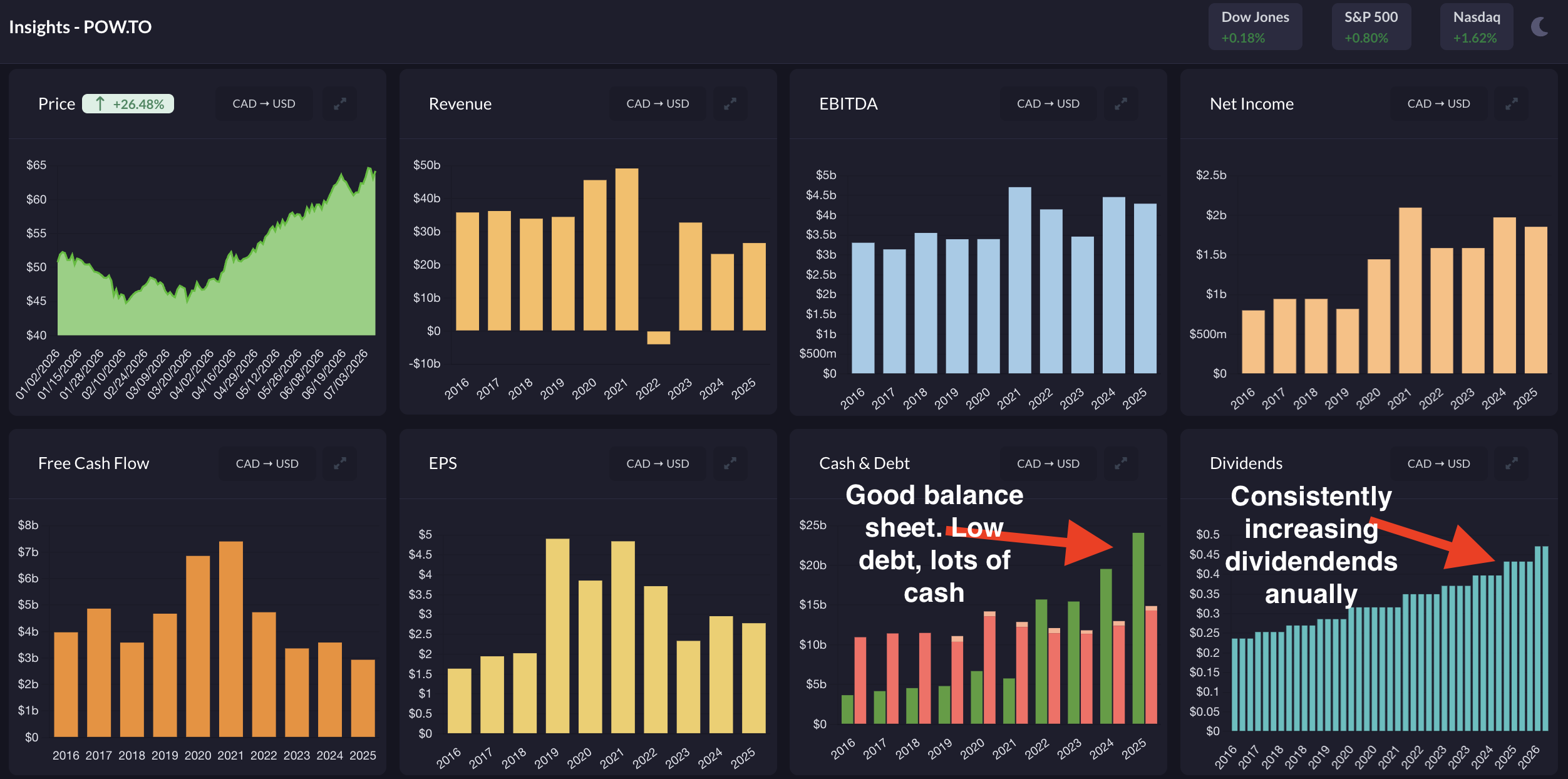
Power Corporation is a Montreal holding company that owns controlling stakes in some of Canada's largest financial businesses, including Great-West Lifeco (Canada Life, Empower, Irish Life), IGM Financial (IG Wealth, Mackenzie), and a growing slice of Wealthsimple. Its stock trades at roughly a 21% discount to what those holdings are worth today, about the discount it has carried for years, so you are buying a dollar of assets for roughly 79 cents.
Catalysts
Wealthsimple's growth: 3.4M clients and $124.8B in client assets, up 71% year over year. It sits in Power's reported NAV at only ~$1.5B directly, so each new funding-round markup lifts NAV, and an eventual IPO would turn that paper value into a hard number.
Underlying earnings momentum: Great-West hit an adjusted return on equity above 19% for the first time, and IGM posted record earnings. As the value of the holdings grows, the stock can climb even if the discount never narrows.
Buybacks: Power repurchased $711M of its own stock in 2025 (12.4M shares) and keeps going. Fewer shares means each remaining share owns a bigger slice of the basket.
Dividend growth: raised 9% in 2026 to $2.67/yr, and grown about 7.8% a year on average over the past decade. A rising, well-covered payout.
Q2 earnings (July 30, 2026): the next read on NAV, earnings, and possibly a fresh Wealthsimple mark.
Discount narrowing: if the market gives more credit for Wealthsimple, the ~21% gap to NAV could shrink and add to returns. Not guaranteed, holding-company discounts tend to be sticky, so treat this as upside rather than the base case.
Key risks
The holdings have run hard: Great-West is up about 42% and IGM about 22% since March 31, and POW is up roughly 60% over the past year, tracking ahead of its own earnings growth. If those stocks pull back, NAV and POW fall together. This is the main near-term risk.
Everything moves together: Great-West (insurance), IGM (asset management), and Wealthsimple all depend on healthy markets. A downturn hits insurance results, fee income, and Wealthsimple's value at the same time, so this is not a diversified basket despite holding several companies.
Concentration: Great-West and IGM are about 83% of the value, both Canadian financials. In effect you own a levered bet on two big financial firms.
The discount can widen: in nervous markets, holding-company discounts get wider, so POW can lag its own NAV for long stretches.
Wealthsimple markdown risk: it is privately valued. If fintech valuations compress, its mark can be cut, trimming NAV.
Family control: the Desmarais family controls Power through multiple-voting shares, so as a holder of subordinate voting shares you have limited say, and decisions are made by a controlling shareholder.
Analyst caution: Street price targets (average ~$84) sit at or below today's ~$90, so professionals see limited near-term upside from here.
Portfolio position
8.0% of TFSA+55.70%
Power Corporation of Canada (POW.TO) Investment Evaluation Brief
Last updated: July 9, 2026
Price at writing:~$90 (July 8, 2026; traded roughly $89-91 the past week), all figures CAD
Market cap: ~$56.7B
Sector: Diversified financials (holding company)
Conviction: High (expected hold: indefinite, owned for years)
Verdict: Hold. Position owned since ~$40 average, so keep holding. Add only small amounts below $85. No trimming and no trading around the position.
Power Corporation is a Montreal holding company that owns controlling stakes in some of Canada's largest financial businesses, including Great-West Lifeco (Canada Life, Empower, Irish Life), IGM Financial (IG Wealth, Mackenzie), and a growing slice of Wealthsimple. Its stock trades at roughly a 21% discount to what those holdings are worth today, about the discount it has carried for years, so you are buying a dollar of assets for roughly 79 cents.
1️⃣ Summary/Snapshot
Power is a basket of established Canadian financial businesses that trades for less than the sum of its parts, and you already own it cheaply. The plan: hold what you have (bought around $40), and add only small amounts if it dips below $85.
Bought cheap, still not expensive: your ~$40 average is a ~6.7% yield on cost today, and even at ~$90 the stock sits about 21% below the current value of its holdings.
A basket of two big financials plus a growth kicker: Great-West Lifeco and IGM Financial are ~83% of the value, with Wealthsimple (3.4M clients, growing fast) as the piece that could re-rate the whole thing higher over time.
The return from here comes from the holdings growing and the dividend rising (raised 9% in 2026, ~3.0% yield), not from a bargain closing. The deep-discount, fat-yield setup you bought in 2020 has mostly played out.
This is a hold, not a trade: no stop, no profit-taking, no trimming. Keep holding until something fundamental changes.
At a Glance
Item
Detail
Verdict
Hold; owned ~$40 avg; add small only < $85
Current price
~$90 (July 8, 2026)
Base-case NAV (fair value of holdings)
~$114 (what the basket is worth today)
Analyst target (avg / median)
~$84 / ~$84 (July 2026)
Moat
Entrenched financial businesses (Great-West, IGM)
Key catalyst
Wealthsimple growth + Q2 earnings (July 30)
Risk to watch
Great-West / IGM pulling back after a big run
Next earnings
July 30, 2026 (Q2 FY2026)
Valuation Summary (NAV: what the holdings are worth per share)
Scenario
NAV per share
vs ~$90 (Jul 8)
Conservative
~$100
~10% below
Base
~$114
~21% below
Bull
~$128
~30% below
The dividend-only method (DDM) puts fair value near ~$94 in its base case, so the income lens agrees the stock is priced about right. Full detail in Section 6.
Notable Analyst Price Targets
Analyst / Firm
Rating
Price Target
Date / Notes
Scotiabank
Sector Outperform
$90
Raised from $79, May 14, 2026 (Street high)
Desjardins
Buy
$87
Doug Young, raised from $81
TD Securities
Hold
$84
Cut to Hold, target raised from $74, May 14, 2026
CIBC
Neutral
$80
Raised from $78
BMO Capital
Market Perform
$79
Tom MacKinnon, raised from $69
Where to Find More Detail
Section 4 (Plain-English): What Power is and why it trades below the value of its parts.
Section 6 (Quantitative Analysis and Valuation): The two valuation methods (holdings and dividend), the scenarios, and the analyst view.
Section 7 (Strategy): The hold-and-add rules.
2️⃣ Catalysts
Wealthsimple's growth: 3.4M clients and $124.8B in client assets, up 71% year over year. It sits in Power's reported NAV at only ~$1.5B directly, so each new funding-round markup lifts NAV, and an eventual IPO would turn that paper value into a hard number.
Underlying earnings momentum: Great-West hit an adjusted return on equity above 19% for the first time, and IGM posted record earnings. As the value of the holdings grows, the stock can climb even if the discount never narrows.
Buybacks: Power repurchased $711M of its own stock in 2025 (12.4M shares) and keeps going. Fewer shares means each remaining share owns a bigger slice of the basket.
Dividend growth: raised 9% in 2026 to $2.67/yr, and grown about 7.8% a year on average over the past decade. A rising, well-covered payout.
Q2 earnings (July 30, 2026): the next read on NAV, earnings, and possibly a fresh Wealthsimple mark.
Discount narrowing: if the market gives more credit for Wealthsimple, the ~21% gap to NAV could shrink and add to returns. Not guaranteed, holding-company discounts tend to be sticky, so treat this as upside rather than the base case.
3️⃣ Key Risks
The holdings have run hard: Great-West is up about 42% and IGM about 22% since March 31, and POW is up roughly 60% over the past year, tracking ahead of its own earnings growth. If those stocks pull back, NAV and POW fall together. This is the main near-term risk.
Everything moves together: Great-West (insurance), IGM (asset management), and Wealthsimple all depend on healthy markets. A downturn hits insurance results, fee income, and Wealthsimple's value at the same time, so this is not a diversified basket despite holding several companies.
Concentration: Great-West and IGM are about 83% of the value, both Canadian financials. In effect you own a levered bet on two big financial firms.
The discount can widen: in nervous markets, holding-company discounts get wider, so POW can lag its own NAV for long stretches.
Wealthsimple markdown risk: it is privately valued. If fintech valuations compress, its mark can be cut, trimming NAV.
Family control: the Desmarais family controls Power through multiple-voting shares, so as a holder of subordinate voting shares you have limited say, and decisions are made by a controlling shareholder.
Analyst caution: Street price targets (average ~$84) sit at or below today's ~$90, so professionals see limited near-term upside from here.
4️⃣ Plain-English Business Explanation
What Power Corporation actually does
Power does not sell a product to you directly. It is a holding company, which means its whole job is to own controlling stakes in other companies and let them run. Think of it as a parent that owns most of several large financial firms and collects the rewards.
The three big things it owns are Great-West Lifeco (a life insurer and retirement company that operates as Canada Life at home, Empower in the US, and Irish Life in Europe), IGM Financial (a wealth and investment manager behind IG Wealth Management and Mackenzie Investments), and a meaningful stake in Wealthsimple, the app you use. It also owns a slice of a European investment holding company (GBL) and two alternative-investment arms (Sagard and Power Sustainable).
How Power makes money
Power earns money because the businesses it owns earn money. Those businesses pay dividends and grow in value, and Power passes cash back to you two ways: a quarterly dividend and buying back its own shares. Over time, if Great-West, IGM, and Wealthsimple grow, the value of Power's basket grows with them.
Who uses it: through its businesses, the Power group serves tens of millions of people. Great-West alone counts roughly 40 million customer relationships across Canada, the US (Empower runs workplace retirement plans), and Europe. Wealthsimple has 3.4 million clients. IGM manages money for Canadians through IG Wealth advisors and Mackenzie funds.
The key debate around the stock (why it trades below the value of its parts)
This is the whole story with Power, so it is worth being clear.
Power's stock is worth about $56.7B on the market. But if you add up the market value of everything it owns and subtract its debt, the holdings are worth roughly $72B, or about $114 per share. So the stock trades well below the value of its own basket. That gap is called a "holding-company discount," and almost every holding company has one.
Why the discount exists: you are buying the businesses second-hand through a middleman, you cannot get at the assets directly, selling any of them would trigger taxes, and the structure is complex and family-controlled. Investors demand a markdown for all of that.
The debate: bulls say the discount is too wide given how fast Wealthsimple is growing, and that it should shrink as Wealthsimple gets bigger and more visible. Bears say holding-company discounts rarely close, and that after a huge run in Great-West and IGM the whole basket could simply cool off. Both are fair. For a long-term holder the discount is less about a quick re-rating and more about the fact that you keep buying the basket cheaply.
A simple analogy
Picture a gift hamper on a store shelf. Inside are items that, bought separately, would cost you $114. The store sells the whole hamper for $90. You are getting everything inside at a discount because it is bundled, and because you cannot pull items out and sell them individually. That bundle discount is exactly what you are getting with Power, and it is why the stock can be a fine thing to own even when it is not a screaming bargain.
record Q1 adjusted earnings $284.3M; assets $314.0B (+14.2% YoY)
Wealthsimple
3.4M clients; $124.8B client assets (+71% YoY)
6️⃣ Quantitative Analysis and Valuation
Why this section looks different: the usual method in these briefs is a discounted-cash-flow (DCF) model, which projects a company's future cash and discounts it to today. That does not work for Power, because Power is a basket of financial businesses whose "cash" is really dividends from insurers and asset managers, where a DCF breaks down. So we use two methods built for a holding company: valuing what it owns (NAV), and valuing the dividend it pays (DDM). NAV is the main tool; the dividend method is a sanity check. There is no stock-based-pay adjustment here, because that is not a meaningful factor for a holding company.
Analyst Ratings
Metric
Value
Consensus
Hold / Moderate Buy (~9-10 analysts: ~4 Buy / ~5-6 Hold / 0-1 Sell)
Average target
~$84 (about 7% below ~$90, July 2026)
Median target
~$84 (about 7% below ~$90, July 2026)
Target range (recent, confirmed)
$79 - $90 (aggregators show older or outlier targets down toward the high-$50s)
Analyst / Firm
Rating
Price Target
Date / Notes
Scotiabank
Sector Outperform
$90
Raised from $79, May 14, 2026 (Street high)
Desjardins
Buy
$87
Doug Young, raised from $81
TD Securities
Hold
$84
Cut to Hold, target raised from $74, May 14, 2026
CIBC
Neutral
$80
Raised from $78
BMO Capital
Market Perform
$79
Tom MacKinnon, raised from $69
Reading: this is the one place the two lenses disagree. Analyst price targets (average ~$84) sit at or below today's ~$90, because their targets bake in a permanent discount to NAV and they are cautious after the big run in Great-West and IGM. The NAV method below says the stock is cheap relative to what it owns. Both are true at once: POW is at a normal discount to a basket that has itself been lifted by a strong 2026 rally.
Method 1: NAV (what Power's holdings are worth)
Plain terms: NAV (net asset value) just means add up the market value of everything Power owns, subtract its debt and preferred shares, and divide by the number of shares. That tells you what one share is really backed by.
Inputs:
Price: ~$90 (July 8, 2026)
Shares outstanding: ~630M (declining via buybacks)
Method: re-mark the publicly traded holdings to today's prices, then add the rest, subtract debt and preferred shares, divide by shares
Great-West (GWO): closed $65.15 on March 31 (confirmed, S&P Market Intelligence data), ~$92.43 now (July 7), up ~42%
IGM: ~$66 on March 31 (best estimate, bracketed by confirmed closes of $63.68 on Mar 13 and $73.23 on Apr 29), ~$80.76 now (July 9), up ~22%
Other holdings (GBL, Sagard, Wealthsimple, Power Sustainable, cash): held at their March 31 marks, next official update at Q2
Re-marking the basket (March 31 to today):
Holding
Mar 31, 2026 ($M)
Move since Mar 31
Live estimate ($M)
Great-West Lifeco
40,169
+42% (GWO $65.15 to ~$92.43)
~56,990
IGM Financial
9,805
+22% (IGM ~$66 to ~$80.76)
~11,997
GBL (Europe)
2,752
held flat
~2,752
Sagard / Wealthsimple / Power Sustainable
4,184
held flat
~4,184
Cash + other
2,942
held flat
~2,942
Total holdings
59,852
~78,865
Less debt and preferred shares
(6,413)
(6,413)
NAV
53,439
~72,452
Shares (M)
632.1
632.1
NAV per share
$84.54
~$114
Valuation Summary:
Scenario
What has to happen
NAV per share
vs ~$90 (Jul 8)
Conservative
Great-West and IGM give back part of their big 2026 run; no Wealthsimple markup
~$100
~10% below
Base
Value the basket at today's actual market prices
~$114
~21% below
Bull
Great-West and IGM climb further, Wealthsimple gets marked up at Q2, buybacks shrink the share count
~$128
~30% below
Interpretation:
At ~$90, you are paying about 21% less than the current value of the basket. Buying below NAV is normal for a holding company and good for you as the buyer.
That ~21% discount is roughly what POW has carried for years, so the stock is not expensive, it is priced about where it usually sits.
The caveat: the base NAV of ~$114 leans heavily on Great-West's ~42% jump since March. If those holdings cool off, NAV drifts back toward the Conservative ~$100, and the discount at ~$90 shrinks to ~10%. So the "cheapness" is real but partly a function of a hot 2026 for the holdings.
The striking way to see it: Power's whole market value (~$56.7B) is almost exactly what its Great-West stake alone is worth (~$57B). At today's price the market is handing you IGM, Wealthsimple, the European stake, and the cash pile close to free, after debt.
Method 2: DDM (the dividend, as a sanity check)
Plain terms: a dividend discount model (DDM) ignores what Power owns and values only the dividend cheque. It asks: if all you cared about was a growing stream of dividends, what is that stream worth today? Two things drive it, how fast the dividend grows and the yearly return you would demand to hold the stock (I have used 9%, a normal ask for a steady financial company). Only the growth rate changes across the scenarios below.
Scenario
Dividend grows forever at
Value per share
vs ~$90 (Jul 8)
Conservative
5% per year
~$70
~29% above this
Base
6% per year
~$94
~4% below this
Bull
7% per year
~$143
~59% below this
Interpretation:
The base case (~$94) lands close to today's ~$90, so on the dividend alone the stock is priced about right.
Notice how far the value jumps for a small change in the growth rate. That is why this method is only a backup, never the headline.
The blind spot: this method values your Wealthsimple stake at zero, because Wealthsimple pays you no dividend. Since Wealthsimple is a big part of why you own this, the NAV method is the one that really counts, and the dividend method just confirms you are not overpaying for the income.
7️⃣ Strategy
Hold. This is a long-term position bought around $40 and it stays a hold. No trading around it, no trimming, no profit-taking. Hold and keep holding until further notice.
Add only small amounts below $85. Below that line you are buying at more than a 25% discount to the current value of the holdings (~$114), a better margin than at today's price. Keep any additions small, since the position is already established and the holdings have run hard.
The one condition: keep holding while the basket keeps growing (Great-West and IGM earnings, Wealthsimple markups, buybacks shrinking the share count) and the dividend keeps rising. Reassess only if NAV growth clearly stalls, or the discount blows out for a real reason rather than a market wobble.
Holding period: indefinite. The return from here is the holdings compounding plus a growing ~3% dividend, collected patiently.
8️⃣ Open Questions
IGM's exact March 31 close is a best estimate (~$66), bracketed by confirmed closes; Great-West's is exact at $65.15. Pinning IGM to the penny moves NAV by under a dollar a share and does not change the ~21% discount.
Does the Q2 report (July 30) show NAV still growing and a fresh, higher Wealthsimple mark?
When, if ever, does Wealthsimple monetize (for example an IPO) to turn its paper value into cash and possibly narrow the discount?
How much of Power's total look-through Wealthsimple value (~$3.8B across the group) is captured in the headline NAV versus sitting inside the IGM and Sagard lines?
Research for personal use. Not investment advice. Verify pricing, share count, NAV composition, and material developments through primary sources before any transaction. NAV is a scenario estimate, not a precise figure; it moves with the market value of Great-West, IGM, and the other holdings.