TradeShare
Options playsTheses
Sign in
Back to Theses

ASML

equityVersion 1

Published Thursday, May 21, 2026

High convictionHorizon: 2 - 5 years

Summary

Monopoly business in the AI build out and chip manufacturing

Catalysts

More capex on AI buildout

Key risks

Downturn in AI spending

Portfolio position

  • 3.8% of RRSP+63.85%

ASML Holding (ASML) Hold Thesis Brief

Sector Classification: Semiconductor Manufacturing Equipment

Layer: Chip Manufacturing (the machines that make the chips)

Verdict: Buy and hold. ASML is a true monopoly on the single most important machine in the modern economy. This is a position to own for years and add to on dips, not to trade.


Why I Own It (Plain English)

Every advanced computer chip in the world (the ones powering AI, phones, data centers) is made using a process called lithography, which is essentially printing unimaginably tiny patterns onto silicon. The most advanced version of this is called EUV (extreme ultraviolet) lithography, and ASML is the only company on Earth that makes EUV machines. Not the best, the only.

If a chipmaker like TSMC, Samsung, Intel, or SK Hynix wants to make a cutting-edge chip, they have no choice but to buy from ASML. There is no competitor. These machines cost hundreds of millions of dollars each, take years to build, contain hundreds of thousands of parts, and require a global supply chain that took decades to assemble. No one can simply decide to compete with ASML; the barrier to entry is one of the widest in the entire economy.

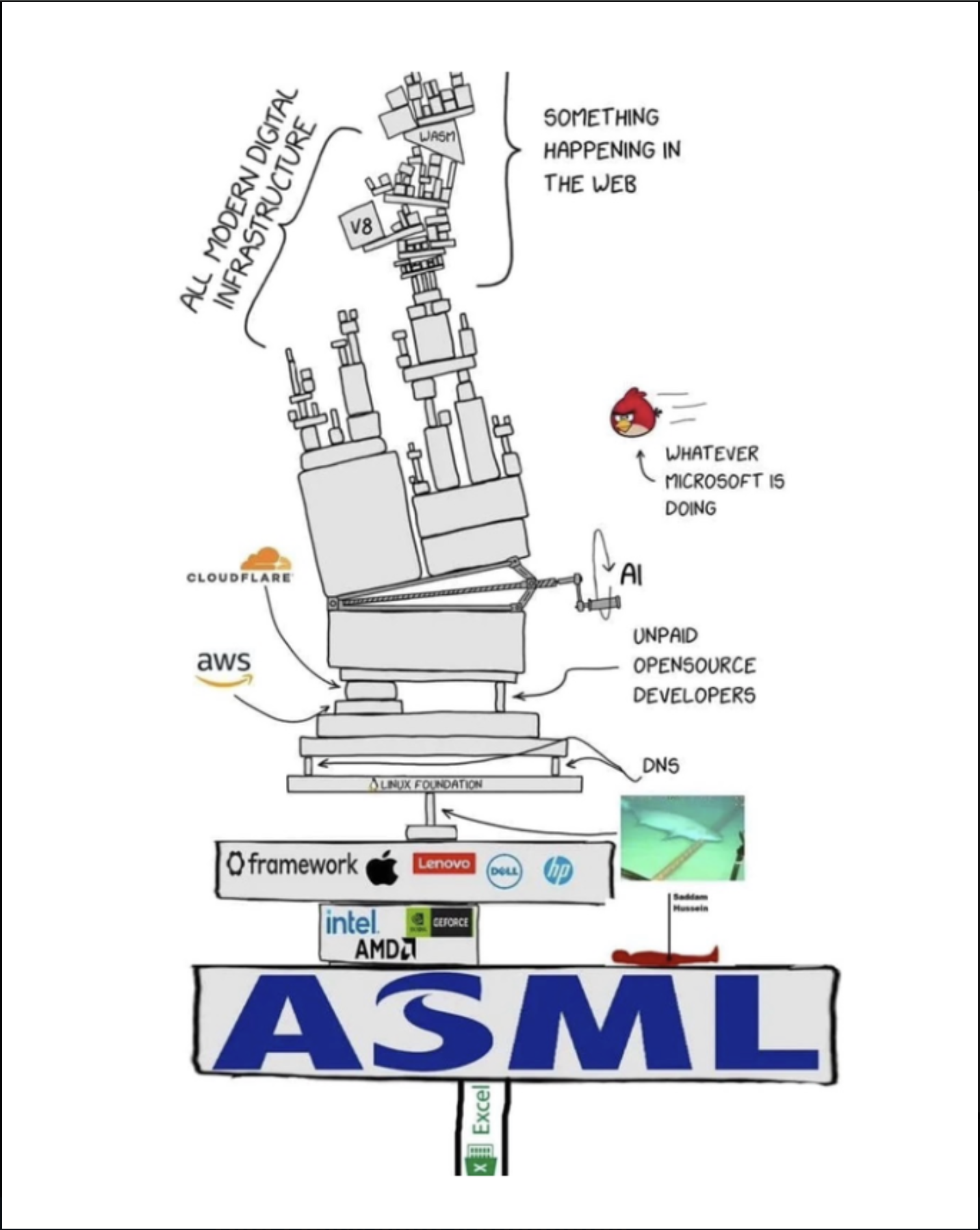
The simple way to think about it: in the AI gold rush, everyone is buying picks and shovels (NVIDIA chips, data centers, power). ASML makes the one machine without which none of those picks and shovels can be manufactured in the first place. It sits at the very top of the funnel for the entire semiconductor industry.

I own ASML because it is one of the rare businesses with a genuine, durable, almost-unassailable monopoly on something the world needs more of every year.

ASML.png

Where ASML Sits in the Chain

ASML is the chokepoint at the start of the whole semiconductor supply chain. Roughly the order is:

  1. ASML builds the EUV lithography machine
  2. Chipmakers (TSMC, Samsung, Intel, SK Hynix) use that machine in their factories
  3. Chip designers (NVIDIA, AMD, Apple, Broadcom) have those factories print their designs
  4. System builders and cloud providers (data centers, hyperscalers) buy the finished chips
  5. AI companies and everyone else rent the computing power Everything downstream of ASML, the entire trillion-dollar AI hardware economy, depends on machines that only ASML can make. That is the position you want to own.

What the Business Looks Like Right Now

The most recent quarter (Q1 2026, reported April 15) confirmed the strength of the franchise:

MetricResultWhat It Means
Quarterly revenue€8.8B, up 13% year-over-yearSteady growth at massive scale
Gross margin53%Monopoly-level profitability
Net income€2.8BHugely profitable
EUV system sales€4.1B (about 65% of system sales)The crown-jewel product is the main driver
2026 full-year guidanceRaised to €36B-€40BManagement is more confident, not less
Order backlog (year-end 2025)~€38.8BMultiple years of revenue already booked
2030 revenue target€44B-€60BA long runway of growth ahead

The key takeaway: ASML raised its outlook for the year, EUV demand is accelerating because of AI, and the company already has tens of billions of euros of orders in the bank. This is a business operating from a position of demand excess, not demand uncertainty.


Why It's a Buy and Hold

  1. It is a real monopoly. ASML is the sole supplier of EUV machines. There is no second source. Monopolies on essential, hard-to-replicate technology are the most valuable businesses to own and the rarest to find.
  2. The technology moat is almost impossibly deep. An EUV machine is one of the most complex objects humans have ever manufactured. Recreating ASML's capability would take a competitor many years, enormous capital, and an entire supply chain that does not currently exist elsewhere. This is why under-$900 dips have historically been excellent buying opportunities: the moat does not change just because the stock price wobbles.
  3. AI makes its machines more essential every year. Every advance in AI requires more advanced chips, and more advanced chips require ASML's machines. The AI boom is, at its foundation, an ASML demand story.
  4. It earns money on machines it already sold. Beyond selling new machines, ASML earns high-margin recurring revenue servicing and upgrading its installed base (about €2.5B per quarter and growing). This provides a steady, profitable income stream on top of new sales.
  5. Years of revenue are already locked in. With a backlog near €39B and a roadmap pointing to €44-60B of revenue by 2030, the company has unusual visibility into its own future. You are not betting on a turnaround; you are owning a compounding monopoly.

Catalysts (What Could Drive It Higher)

  • High-NA EUV ramping up. ASML's next-generation machine (High-NA EUV) is just beginning to roll out to customers. As these even more advanced and more expensive machines start shipping in volume, they add a whole new layer of growth on top of the existing business.

  • Memory becomes a second engine. Historically EUV demand came mostly from logic chips. Now memory makers (the companies building the HBM memory that AI chips need) are adopting EUV too. This effectively gives ASML a second independent growth cycle.

  • Continued AI capital spending. As long as the big chipmakers and cloud companies keep racing to build AI capacity, they keep ordering ASML machines. Each new wave of AI investment flows back to ASML at the source.

  • Guidance raises. ASML already raised its 2026 outlook once this year. Further upward revisions, or strong order numbers each quarter, tend to reassure the market and support the stock.

Key Risks (What Could Go Wrong)

  • It is cyclical. The semiconductor industry moves in boom-and-bust cycles. Even with a monopoly, ASML's sales can slow sharply when chipmakers pause spending. The stock can fall hard during these down-cycles even though the long-term franchise is intact, which is exactly what creates the dip-buying opportunities.

  • China and export restrictions. A meaningful chunk of past sales went to China, and governments (especially the U.S. and Netherlands) have been restricting what ASML can sell there. China fell to about 19% of system sales recently, down from 36%. Further restrictions could pressure that part of the business, though it is concentrated in older, lower-margin machines.

  • Customer concentration. ASML sells to a tiny number of giant customers (TSMC, Samsung, Intel, SK Hynix). If even one of them delays a major fab project, it can move ASML's numbers noticeably in a given quarter.

  • High expectations. ASML is widely recognized as a great business, so the stock is rarely cheap. When expectations are high, even good results can disappoint if they are not great, leading to short-term drops. This is a reason to buy dips patiently rather than chase highs.


Bottom Line

ASML is the definition of a buy-and-hold quality monopoly: the only maker of the one machine the entire advanced-chip world depends on, protected by a technology moat that is almost impossible to cross, with AI driving demand higher every year. The genuine risks are the industry's natural boom-bust cycle and the politics of China export restrictions, both of which can knock the stock down temporarily. But those dips have historically been gifts, not warnings. The plan is to hold for the long term and add on meaningful weakness, treating any drop driven by the cycle or headlines as an opportunity rather than a reason to sell.


This document is research for personal use. Not investment advice. Verify pricing and material developments through primary sources before any transaction.


Reference Material

  • Joseph Carlson, ASML thesis: https://youtu.be/JR6fjgIBm2I?t=159
  • Why the sub-$900 dip was a great buy: https://www.youtube.com/watch?v=P15oUHyGDkk
  • The complexity of ASML technology and its moat (buy-and-hold case): https://www.youtube.com/watch?v=MiUHjLxm3V0
  • Visual of ASML's role in the semiconductor chain: https://x.com/investingvisual/status/2015849970159460560