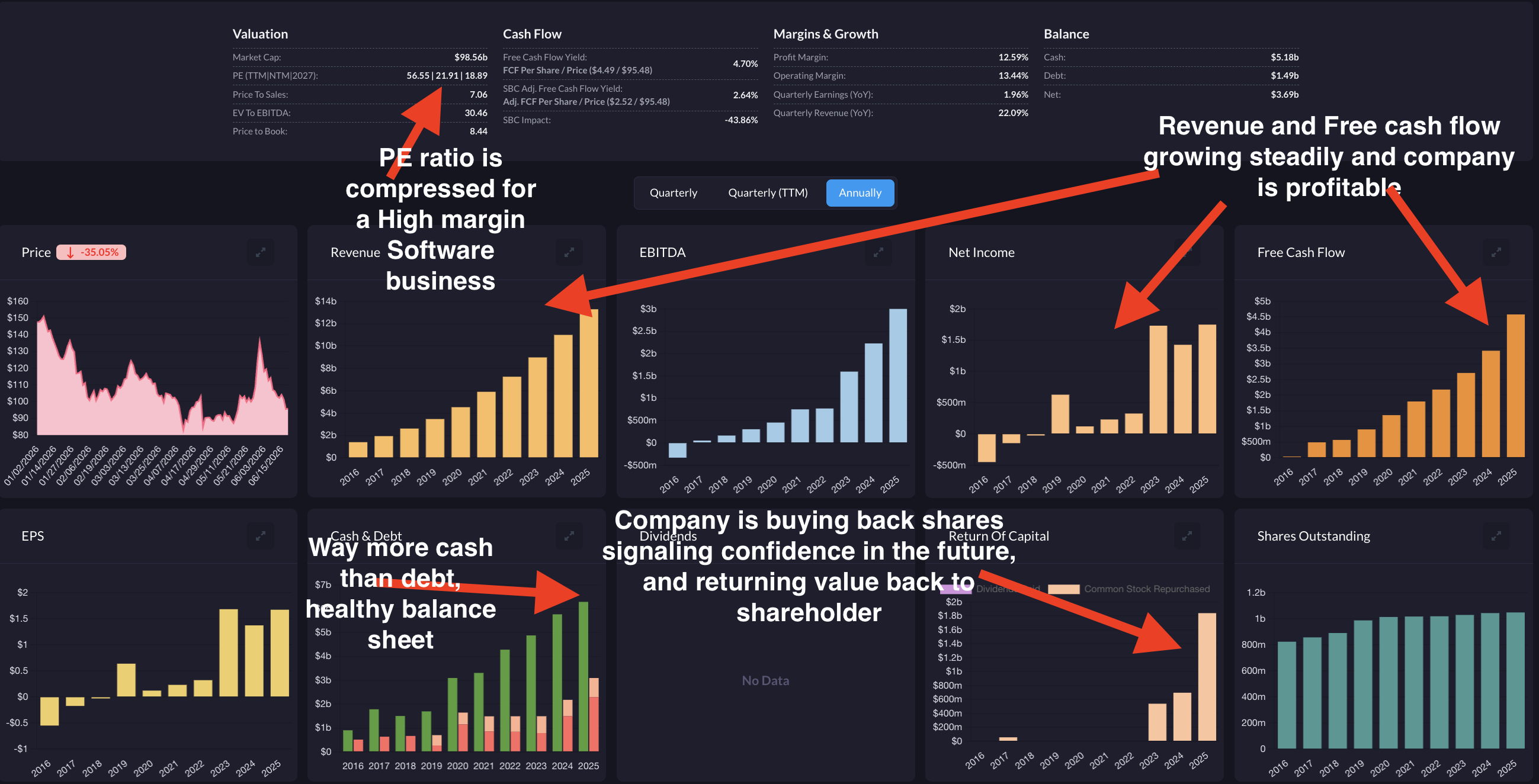
ServiceNow runs the software that most of the Fortune 500 use to automate their internal work, from IT tickets to HR to security, with customers ranging from General Mills and Warner Bros. Discovery to government agencies like the U.S. Department of Energy. Its stock has been cut by more than half from its 2025 high and recently slid back near its lows (to ~$95 on June 18, 2026) on renewed fears that AI will make software like this obsolete, even though the business kept growing the whole time.
Catalysts
NVIDIA partnership: ServiceNow's AI control tool is now built into NVIDIA's blueprint for enterprise AI. In plain terms, that positions NOW as the layer that manages and oversees AI agents running on NVIDIA's technology, which supports the "AI helps NOW" case.
July 29 earnings: The next real test. A beat with organic growth holding up and guidance raised would push back on the deceleration fear that drove the stock down to ~$95.
A re-rating if the AI fear fades: The discount exists mainly because investors fear AI will make ServiceNow obsolete. That fear pulled the late-May rally back down to ~$95. If a clean quarter or visible AI monetization flips sentiment, the price multiple can recover. Several analysts already call the fear overblown.
Share buybacks: ServiceNow bought back ~20M of its own shares in Q1 2026, and its board added $5B to the buyback program in January 2026. A company buying its own stock is a vote of confidence that the shares are cheap, and it returns value to shareholders by leaving fewer shares outstanding (each one then owns a bigger slice). At ~$95, those dollars buy back more stock.
Trump portfolio presence (minor, sentiment only): Trump's Q1 2026 disclosure shows a new ServiceNow position (a $1M-$5M buy made during the February software selloff), with an estimated average entry of ~$115-$130, near recent levels. A positioning and sentiment signal, not a fundamental driver, and the assets are held in a trust managed by others. Analysis: Trump Q1 2026 Disclosure, Estimated Average Buy Prices
Key risks
AI disruption (the big one): If AI agents genuinely replace workflow coordination, the moat erodes. The realistic timeline is years, but it is the risk that matters most, and it is what the market is pricing in right now.
Growth cooling (the active worry): Subscription sales grew ~22% in Q1, but the full-year outlook was not raised on an organic basis, which is what spooked investors. If growth slips toward 15% or below, they will pay less and the stock can keep sliding even with the business still healthy.
Stock-based pay dilution: ServiceNow pays employees heavily in shares (~$1.955B in FY2025, about 43% of free cash flow). That dilutes owners, and the buyback only partly offsets it. It is the main reason the cash flow is worth less than the headline FCF suggests (see Section 6).
Acquisition costs: NOW recently bought two companies (Veza and Armis). Absorbing them costs money and can dent profit margins for a while, with the usual risk that the integration is bumpy.
Portfolio position
7.3% of TFSA+9.90%
ServiceNow (NOW) Investment Evaluation Brief
Last updated: June 21, 2026
Price at writing:~$95.04 (June 18, 2026 close, Yahoo Finance)
Market cap: ~$98B
Sector: Enterprise software (workflow automation)
Conviction: High (expected hold: 3-5+ years)
Verdict: Buy under $120, double down under $100. At ~$95 it is now in the double-down zone. Build via DCA.
ServiceNow runs the software that most of the Fortune 500 use to automate their internal work, from IT tickets to HR to security, with customers ranging from General Mills and Warner Bros. Discovery to government agencies like the U.S. Department of Energy. Its stock has been cut by more than half from its 2025 high and recently slid back near its lows (to ~$95 on June 18, 2026) on renewed fears that AI will make software like this obsolete, even though the business kept growing the whole time.
1️⃣ Summary/Snapshot
ServiceNow is a high-quality business its customers (over 85% of the Fortune 500) cannot easily leave, yet it is still priced as an AI loser when the likelier outcome is that AI makes it more essential, helped by its NVIDIA partnership. The plan: buy under $120, double down under $100. At ~$95 (June 18, 2026) it now sits in the double-down zone.
77.5% gross margins, ~$4.5B free cash flow, ~22% revenue growth, and customers spending 30%+ more each year.
Hard-to-replace business:
The selloff is about AI fear, NOT the business: Q1 2026 (Apr 22) beat the high end of guidance (revenue and subscription both +22%), yet the stock fell 17.7% that day, and a late-May rally has since reversed to ~$95.
The bet: NOW is the "AI control tower" that coordinates AI agents across a company, and its NVIDIA partnership (NOW's tool is now built into NVIDIA's enterprise-AI blueprint) is concrete evidence of that role.
At ~$95 (June 18, 2026) it sits in the double-down zone, and even a harsh test that charges all stock-based pay with no buyback credit puts the base case (~$82-113) near today's price, so $95 is a fair entry rather than an overpay. Build via DCA (dollar-cost averaging: buying in fixed installments over time instead of all at once) while growth is not clearly slowing.
At a Glance
Item
Detail
Verdict
Buy < $120 · Double down < $100 (now in the double-down zone)
Current price
~$95.04 (June 18, 2026 close)
Base-case fair value
$142-197 (+49% to +107% vs ~$95, June 18)
Base FV (SBC-adjusted)
$82-113 (-14% to +19% vs ~$95, June 18)
Analyst target (avg / median)
~$142 / ~$140 (+49% / +47% vs ~$95, June 18)
Moat
Wide (Morningstar's highest rating)
Key catalyst
NVIDIA partnership + July 29 earnings
Risk to watch
Organic growth slowing below ~15%
Next earnings
~July 29, 2026 (Q2 FY2026)
Valuation Summary
Scenario
Fair Value / Share
vs ~$95 (June 18)
Conservative
$87 - $114
-8% to +20%
Base
$142 - $197
+49% to +107%
Bull
$190 - $265
+100% to +179%
SBC-adjusted base case (charging full stock-based pay, no buyback credit): ~$82-113. See Section 6 for the full SBC-adjusted view.
Notable Analyst Price Targets
Analyst / Firm
Rating
Price Target
Date / Notes
Goldman Sachs
Buy
$163
Cut from $188 post-Q1 (Apr 2026)
Morningstar
Fair value
$151
Mar 5, 2026
BTIG
Buy
$150
Apr 24, 2026
Mizuho
Buy
$140
Cut post-Q1
Benchmark
Buy
$130
Raised to $130 from $125, Jun 15, 2026
Needham
Buy
$115
Cut post-Q1
Where to Find More Detail
Section 4 (Plain-English): What the business does and the AI debate.
Section 6 (Quantitative Analysis and Valuation): Consensus targets, scenario math, the SBC-adjusted view, and the growth stress test.
Section 7 (Strategy): Buy and double-down rules.
2️⃣ Catalysts
NVIDIA partnership: ServiceNow's AI control tool is now built into NVIDIA's blueprint for enterprise AI. In plain terms, that positions NOW as the layer that manages and oversees AI agents running on NVIDIA's technology, which supports the "AI helps NOW" case.
July 29 earnings: The next real test. A beat with organic growth holding up and guidance raised would push back on the deceleration fear that drove the stock down to ~$95.
A re-rating if the AI fear fades: The discount exists mainly because investors fear AI will make ServiceNow obsolete. That fear pulled the late-May rally back down to ~$95. If a clean quarter or visible AI monetization flips sentiment, the price multiple can recover. Several analysts already call the fear overblown.
Share buybacks: ServiceNow bought back ~20M of its own shares in Q1 2026, and its board added $5B to the buyback program in January 2026. A company buying its own stock is a vote of confidence that the shares are cheap, and it returns value to shareholders by leaving fewer shares outstanding (each one then owns a bigger slice). At ~$95, those dollars buy back more stock.
3️⃣ Key Risks
AI disruption (the big one): If AI agents genuinely replace workflow coordination, the moat erodes. The realistic timeline is years, but it is the risk that matters most, and it is what the market is pricing in right now.
Growth cooling (the active worry): Subscription sales grew ~22% in Q1, but the full-year outlook was not raised on an organic basis, which is what spooked investors. If growth slips toward 15% or below, they will pay less and the stock can keep sliding even with the business still healthy.
Stock-based pay dilution: ServiceNow pays employees heavily in shares (~$1.955B in FY2025, about 43% of free cash flow). That dilutes owners, and the buyback only partly offsets it. It is the main reason the cash flow is worth less than the headline FCF suggests (see Section 6).
Acquisition costs: NOW recently bought two companies (Veza and Armis). Absorbing them costs money and can dent profit margins for a while, with the usual risk that the integration is bumpy.
4️⃣ Plain-English Business Explanation
What ServiceNow actually does
ServiceNow is the operating system for how large companies run their internal operations. It connects different departments (IT, HR, customer service, security) and automates the routine work employees would otherwise do by hand.
A simple example: when a new employee joins, one request can automatically trigger IT to set up their laptop, HR to process paperwork, and security to grant building access, all tracked in one place. Without ServiceNow, each of those steps is a separate chain of emails and manual follow-ups across different systems.
The platform sits at the center of operations, which creates very high switching costs (the cost and hassle of ripping it out and replacing it). Once a company builds its workflows on ServiceNow, removing it means rebuilding years of custom processes across every department, a project most technology chiefs would never approve. That is the source of the moat (the durable advantage that keeps competitors out).
Who uses it: over 85% of the Fortune 500. General Mills and Warner Bros. Discovery run internal operations on it, and the U.S. Department of Energy replaced a tangle of legacy IT systems with ServiceNow and cut its IT management costs by about 40%, a concrete example of the switching-cost moat in action.
Business model: land and expand
ServiceNow usually enters a company through the IT department, then expands into HR, customer service, and security over time. Existing customers spend 30%+ more each year (net dollar retention above 130%, meaning the same group of customers grows its spending faster than any customers leave, before a single new customer is added). The company estimates its total market opportunity at $220B+ and targets $30B+ in revenue by 2030.
How ServiceNow connects to AI
This is the entire debate around the stock, so it is worth being precise.
The bear view (why the stock fell): AI agents that can reason and operate software might replace the workflow layer ServiceNow sells. If a company can point an AI agent at a task, why pay for ServiceNow?
The bull view (the thesis): ServiceNow is positioning itself as the "AI control tower," the governed, auditable layer that coordinates AI agents, software robots, and people across an organization. Its value comes from coordinating work across the whole company, not from a single task an AI agent could trivially replace. Through Now Assist it builds AI into its own platform to raise spend per customer rather than be replaced by it. The deepening NVIDIA partnership is concrete evidence of this positioning.
The honest framing: the bear risk is real and worth respecting, but the bet here is that it is overblown. The likelier outcome is that AI makes ServiceNow more valuable to its customers, not less: the company can build AI features into the platform and charge for them, and customers are not going to tear out a trusted, deeply embedded system to replace it with tools they cobble together in-house. The main thing to watch is pricing. If AI lets customers get the same work done with fewer human seats, ServiceNow may need to rethink how it charges (shifting toward pricing based on AI usage or results, rather than purely charging per user) so that delivering more value still shows up as more revenue.
A simple analogy
ServiceNow is the air-traffic-control tower of a large company. The individual planes (departments, tasks, AI agents, employees) can be fast and capable on their own, but without a tower coordinating them you get chaos and collisions. ServiceNow is the tower: it does not fly the planes, it makes sure all of them move in a coordinated, safe, recorded way. Faster planes (AI agents) do not remove the need for the tower; if anything, more traffic makes the tower more essential.
Key business metrics
Metric
Value
Revenue (TTM)
$13.28B (+21% YoY)
Free cash flow
~$4.5B
Gross margin
77.5%
Net dollar retention
130%+
Customer retention
98%+
Morningstar moat
Wide (highest designation)
2030 revenue target
$30B+
5️⃣ Current Data Snapshot
Pricing and valuation (June 18, 2026 close):
Metric
Value
Price
~$95.04 (June 18, 2026 close)
Market cap
~$98B
Shares outstanding
~1.04B (post 5:1 split, Dec 2025)
52-week range (split-adjusted)
$81.24 - $211.48
Net cash
~$4B (approx, unconfirmed post bond issuance + Veza/Armis)
Forward / trailing P/E
~22x / ~57x
Next earnings
~July 29, 2026 (Q2 FY2026)
Q1 2026 results (reported Apr 22) and FY2026 guidance:
Reading: A clear Strong Buy, and the median (~$140) and average (~$142) lining up means the average is not skewed by outliers. The spread is wide ($85 to $226), but the middle of the pack still implies roughly +47% from ~$95. The debate is about the growth rate and the price multiple, not about business quality or solvency.
DCF Valuation
A DCF (discounted cash flow) estimates what the business is worth today by projecting its future free cash flow (the cash left after running and investing in the business) and discounting it back to today's value.
Inputs:
Price (June 18, 2026): ~$95.04
Shares outstanding: ~1.04B
FY2025 revenue: ~$13.0B
FY2025 free cash flow: ~$4.5B (~35% margin)
Net cash: ~$4B (approx, unconfirmed post bond issuance + Veza/Armis)
Forecast method: Two-stage (years 1-5, then 6-10) plus a terminal value
Discount rates: 9-11%
The per-share fair values below are unchanged from the prior version, because the business fundamentals (FY2025 cash flow, share count, growth assumptions) have not changed since the last report. Only the current price moved, so the comparisons are now measured against ~$95.
Historical free cash flow (what informed the growth rates):
Fiscal Year
FCF ($B)
YoY growth
Revenue ($B)
FCF margin
2020
1.37
-
4.52
~30%
2021
1.80
+32%
5.90
~31%
2022
2.17
+21%
7.25
~30%
2023
2.70
+24%
8.97
~30%
2024
3.42
+26%
10.98
~31%
2025
~4.5
+32%
~13.0
~35%
Free cash flow grew ~21-32% over five years (about a 27% yearly average). The growth assumptions below step down from that pace.
Bull (26%) roughly continues the trend. Base (20%) assumes a step-down. Conservative (12%) is about half the historical rate, the stress case.
Valuation Summary:
At ~$95 (June 18, 2026), the stock sits inside the Conservative range ($87-$114), near its top, and well below the Base range ($142-$197). Unlike at ~$124, you are now buying within the stress-case band itself, which is what the double-down line was designed to capture.
The Base case ($142-197) brackets the Street's ~$142 average and ~$140 median targets and Morningstar's $151 fair value; the Bull case sits well above all of them.
Stress test: If Stage 1 FCF growth halves to ~10%, base-case fair value drops to roughly $89, just below the current ~$95. At ~$124 that stress case was about 28% below the price; at ~$95 it is only a few percent below, so the margin of safety has improved substantially.
Why the buy lines sit where they do: Under $120 the downside to the Conservative case shrinks toward zero. Under $100 you are buying into the Conservative range itself, which is the double-down line, and at ~$95 you are there now.
SBC-Adjusted View
Reported free cash flow adds back stock-based compensation (SBC, the value of shares and options paid to employees) because it is not a cash outflow. But it is a real cost to you as a shareholder: those shares dilute your ownership. This view re-runs the DCF treating the full SBC as if it were a cash cost, which is the conservative way to see what the cash flow is worth to owners.
Buyback offset: The board authorized $5B for repurchases in January 2026, aimed at offsetting dilution. Because that program was barely active in 2025, the figures below credit none of it, so treat them as a conservative floor that the buyback should lift over time.
SBC-adjusted fair value / share (brackets show upside/downside vs ~$95, June 18, 2026):
Scenario
9% discount
10% discount
11% discount
Conservative
~$66 (-31%)
~$58 (-39%)
~$51 (-46%)
Base
~$113 (+19%)
~$96 (+1%)
~$82 (-14%)
Bull
~$152 (+60%)
~$127 (+34%)
~$109 (+15%)
For reference, the headline base case at the same rates runs ~$142-197 (+49% to +107%). Charging full SBC roughly halves the cash-flow value.
Reading: Once all SBC is treated as a cost, the base case (~$82-113) brackets today's ~$95, the conservative case (~$51-66) sits well below it, and only the bull case (~$109-152) clears it comfortably. The headline DCF assumes SBC is free; this view assumes you pay for all of it with no buyback credit. The honest fair value sits between the two, and NOW's $5B buyback is the lever that pulls it back toward the headline numbers over time.
7️⃣ Strategy
Buy under $120. Accumulate gradually via DCA. (At ~$95 on June 18, 2026 it is well under this line.)
Double down under $100. Roughly double the cash used per buy. At ~$95 it is in this zone now, so deploy the larger DCA increments while growth is not clearly slowing.
One condition: Keep buying only while growth is not clearly slowing. If growth clearly decelerates (for example, revenue growth below 15% for two straight quarters, or customer retention rolling over), pause and reassess before adding more. Q1 was +22%; the July 29 report is the next check.
Holding period: 3-5+ years to let the AI-control-tower thesis prove out (or not).
8️⃣ Open Questions
Does Q2 2026 (July 29) show organic growth holding and guidance rising, or does deceleration confirm the fear that drove the stock to ~$95?
Exact net cash after the bond sale and the Veza/Armis acquisitions (the DCF used ~$4B, still unconfirmed).
Is Now Assist driving measurable extra spend per customer? Management raised its AI revenue goal to ~$1.5B, but the dollars-per-customer impact still needs confirmation.
Was the slide to ~$95 an overreaction to organic-growth fears, or an early sign the deceleration is real?
Research for personal use. Not investment advice. Verify pricing, share count, net cash, and material developments through primary sources before any transaction. The DCF is a scenario tool, not a prediction; small changes in growth and discount-rate assumptions move fair value a lot for a long-duration holding like this.