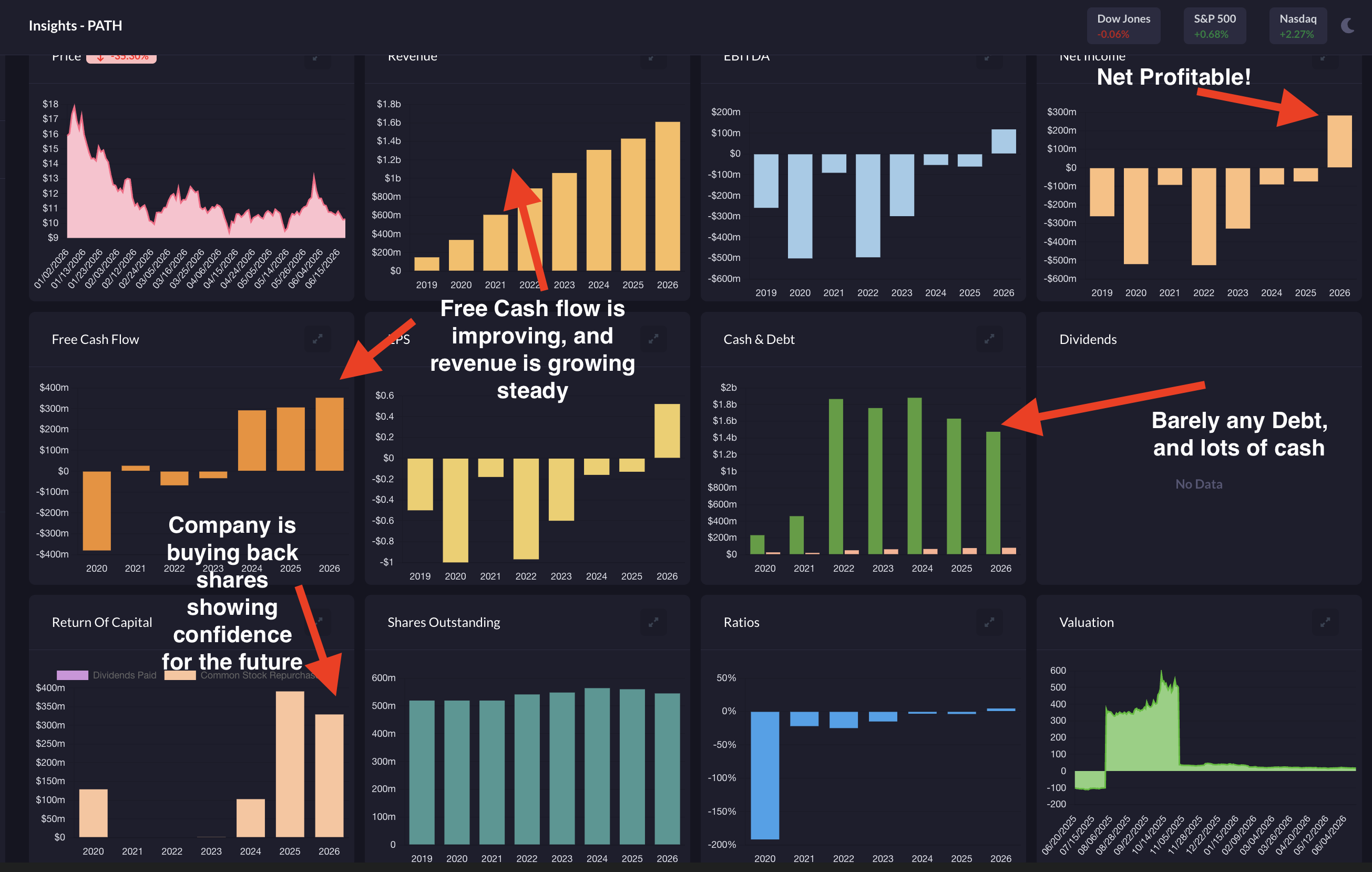
UiPath sells the software robots that automate repetitive office work for thousands of large enterprises across banking, insurance, and healthcare, and is now betting it can become the trusted layer that also coordinates AI agents. Its stock has been cut roughly in half from its 52-week high to ~$10 on fears that AI agents will make its core product obsolete, even as the company just turned its first full-year profit.
Catalysts
A re-rating as the growth gets recognized: The stock dropped ~50% on AI-disruption fear while the business kept growing and turned profitable. If continued steady growth and the agentic products convince the market the fear is overdone, the price multiple can recover toward the reported-cash-flow and analyst range. This re-rating is the core of the upside case.
The agentic pivot turning into growth: UiPath is repositioning from "software robots" to orchestrating AI agents, robots, and people together (its Maestro product). One year into general availability, management says these products are moving from pilots to production. If that lifts recurring-revenue growth back above the current ~12%, the stock can re-rate.
A deep partner and integration ecosystem: UiPath has built integrations with Microsoft, OpenAI, NVIDIA, Snowflake, and Databricks, plus an expanded Deloitte alliance for "agentic ERP." This positions it as a coordination layer for enterprise AI rather than a standalone tool.
Proven profitability and capital return: The company hit its first full-year profit in FY2026, raised its long-term operating-margin target to 30%, and authorized a new $500M buyback after completing a $1B program. A company buying back stock at depressed prices supports the share count and signals management thinks shares are cheap.
Sep 3 earnings: The next test of whether growth is stabilizing or still slowing. A revenue and recurring-revenue beat with steady guidance would push back on the deceleration worry.
Key risks
AI agents replacing the core product (the big one): UiPath's foundation is robotic process automation (RPA, software robots that mimic human clicks to move data between systems). If general-purpose AI agents can do that work directly, the core business erodes. The whole bull case rests on UiPath becoming the orchestration layer instead of the roadkill, and that is not yet proven.
Growth is slowing: Recurring revenue is growing ~12% and decelerating, and the measure of how much existing customers expand spending (net revenue retention) has slipped to about 107%. If growth keeps fading, the market pays less even with the business profitable.
Heavy stock-based pay dilutes owners: UiPath pays employees a large amount in stock (~$207M a year, roughly 56% of free cash flow). That is the main reason the honest cash flow (~$165M) is far below the reported figure (~$372M). The buyback offsets some of the dilution but consumes the very cash it generates.
Founder and insider selling: CEO and founder Daniel Dines has been selling shares under a pre-scheduled plan, and nearly all of his pay is in stock. Not alarming on its own, but worth watching alongside the heavy company-wide stock comp.
Portfolio position
17.5% of FHSA+9.13%
2.1% of TFSA+13.91%
UiPath (PATH) Investment Evaluation Brief
Last updated: June 24, 2026
Price at writing:~$10.20 (June 24, 2026)
Market cap: ~$5.5B
Sector: Enterprise software (automation and agentic AI)
Layer: Software, Services, and Enablement
Conviction: Medium (weighted score 3.50 / 5.0; expected hold 3-5 years)
Verdict: Buy under ~$12, double down under ~$10.50. At ~$10.20 it is in the double-down zone. The low share price makes it easy to accumulate. Build via DCA.
UiPath sells the software robots that automate repetitive office work for thousands of large enterprises across banking, insurance, and healthcare, and is now betting it can become the trusted layer that also coordinates AI agents. Its stock has been cut roughly in half from its 52-week high to ~$10 on fears that AI agents will make its core product obsolete, even as the company just turned its first full-year profit.
1️⃣ Summary/Snapshot
UiPath is a profitable software business that is still growing, slowly but steadily, and the bet is that the market re-rates it upward as that growth keeps showing up. The plan: buy under ~$12, double down under ~$10.50. At ~$10.20 it is in the double-down zone.
Still growing, and the re-rating is the bet: Revenue rose 17% last quarter and recurring revenue 12%, and the company just turned its first full-year profit. The stock fell ~50% on fear that AI will make it obsolete; the thesis is that as steady growth keeps showing up, the market re-rates the price back toward where the cash flow and analysts say it belongs. At ~$10 a share it is also easy to accumulate gradually.
The honest valuation, so you know what you are paying: On reported cash flow it looks cheap (base ~$15-20). Charge the heavy stock-based pay and the honest value is lower: the blended SBC-adjusted fair value is about $9.43, just below today's ~$10.20. So you are paying roughly honest fair value now, and the upside comes from the re-rating, NOT from a discount today.
The downside is cushioned by the balance sheet: About $1.42B of net cash and no debt, roughly $2.61 a share or a quarter of the price. That floor is what makes buying around fair value comfortable while the growth story plays out.
The debate: Bull case, UiPath becomes the governed layer that coordinates AI agents; bear case, AI agents replace its core robots. Analysts sit on the sidelines (consensus Hold, average target ~$13.30, about +30%).
At a Glance
Item
Detail
Verdict
Buy < ~$12 · Double down < ~$10.50
Current price
~$10.20 (June 24, 2026)
Base-case fair value (reported FCF)
$15-$20 (+47% to +96% vs ~$10.20, June 24)
Base FV (SBC-adjusted)
$8-$10 (-19% to +1% vs ~$10.20, June 24)
Probability-weighted fair value (SBC-adjusted)
~$9.43 (-8% vs ~$10.20, June 24)
Analyst target (avg / median)
~$13.30 / ~$13.44 (+30% / +32% vs ~$10.20, June 24)
Moat
Moderate (installed base and orchestration; AI-threatened)
Key catalyst
Re-rating as growth is recognized + Sep 3 earnings
Risk to watch
AI agents disrupting the core product
Next earnings
~Sep 3, 2026 (Q2 FY2027)
Valuation Summary
Scenario
Fair Value / Share (reported FCF)
vs ~$10.20 (June 24)
Conservative
$13 - $16
+26% to +61%
Base
$15 - $20
+51% to +97%
Bull
$19 - $26
+89% to +155%
SBC-adjusted base case (charging full stock-based pay, no buyback credit): ~$8-$10, with a blended fair value of ~$9.43. See Section 6 for the full SBC-adjusted view. This is the more honest lens for PATH.
Notable Analyst Price Targets
Firm
Rating
Price Target
Date / Notes
RBC Capital
Buy
$19
Most recent high-end update
Morgan Stanley
Overweight
$17
Street high in consensus
BofA Securities
Neutral
$13
Raised from $12
DA Davidson
Neutral
$12
Lowered from $13
Truist
Hold
$12
Near Street low
Needham
Buy
(n/a)
Upgraded to Buy after Q4
Where to Find More Detail
Section 4 (Plain-English): What the business does and the AI debate.
Section 6 (Quantitative): Consensus targets, the scenario math, and the SBC-adjusted view that matters most here.
Section 7 (Six-Category Evaluation): The scored framework that sets the conviction rating.
Section 8 (Strategy): The buy and double-down rules.
2️⃣ Catalysts
A re-rating as the growth gets recognized: The stock dropped ~50% on AI-disruption fear while the business kept growing and turned profitable. If continued steady growth and the agentic products convince the market the fear is overdone, the price multiple can recover toward the reported-cash-flow and analyst range. This re-rating is the core of the upside case.
The agentic pivot turning into growth: UiPath is repositioning from "software robots" to orchestrating AI agents, robots, and people together (its Maestro product). One year into general availability, management says these products are moving from pilots to production. If that lifts recurring-revenue growth back above the current ~12%, the stock can re-rate.
A deep partner and integration ecosystem: UiPath has built integrations with Microsoft, OpenAI, NVIDIA, Snowflake, and Databricks, plus an expanded Deloitte alliance for "agentic ERP." This positions it as a coordination layer for enterprise AI rather than a standalone tool.
Proven profitability and capital return: The company hit its first full-year profit in FY2026, raised its long-term operating-margin target to 30%, and authorized a new $500M buyback after completing a $1B program. A company buying back stock at depressed prices supports the share count and signals management thinks shares are cheap.
Sep 3 earnings: The next test of whether growth is stabilizing or still slowing. A revenue and recurring-revenue beat with steady guidance would push back on the deceleration worry.
3️⃣ Key Risks
AI agents replacing the core product (the big one): UiPath's foundation is robotic process automation (RPA, software robots that mimic human clicks to move data between systems). If general-purpose AI agents can do that work directly, the core business erodes. The whole bull case rests on UiPath becoming the orchestration layer instead of the roadkill, and that is not yet proven.
Growth is slowing: Recurring revenue is growing ~12% and decelerating, and the measure of how much existing customers expand spending (net revenue retention) has slipped to about 107%. If growth keeps fading, the market pays less even with the business profitable.
Heavy stock-based pay dilutes owners: UiPath pays employees a large amount in stock (~$207M a year, roughly 56% of free cash flow). That is the main reason the honest cash flow (~$165M) is far below the reported figure (~$372M). The buyback offsets some of the dilution but consumes the very cash it generates.
Founder and insider selling: CEO and founder Daniel Dines has been selling shares under a pre-scheduled plan, and nearly all of his pay is in stock. Not alarming on its own, but worth watching alongside the heavy company-wide stock comp.
4️⃣ Plain-English Business Explanation
What UiPath actually does
UiPath makes software robots that do repetitive computer tasks for big companies: copying data between systems, processing invoices, onboarding employees, handling insurance claims. Instead of a person clicking through five different programs to complete one task, a UiPath robot does it automatically, around the clock.
The newer story is "agentic automation." On top of the old reliable robots, UiPath now adds AI agents (software that can reason and decide, not just follow fixed steps) and, crucially, a control layer (called Maestro) that coordinates robots, AI agents, and human workers together in one governed, auditable workflow. The pitch is that as companies deploy AI agents, they need a trusted system to manage them so they do not run amok in mission-critical processes.
The company sells this as a subscription, measured by annual recurring revenue (ARR, the annualized value of all active subscriptions). ARR is about $1.9 billion and growing ~12% a year.
Business model
UiPath lands inside a company with one automation use case, then expands across departments. It is a software business with very high gross margins (~83%), so once it covers its costs, additional revenue is highly profitable. The challenge is that growth has slowed from the 20%+ of its early years to about 12% now.
Who uses it: Thousands of organizations, including a large share of the Global 2000, with deep adoption in banking, insurance, and healthcare (for example, anti-money-laundering checks via its WorkFusion acquisition and medical-record summarization for hospitals). It works hand in hand with Microsoft, OpenAI, Deloitte, and Databricks.
How it connects to AI (the central debate)
This is the entire argument around the stock.
The bear view (why the stock fell): If general-purpose AI agents can directly operate software, who needs UiPath's robots? AI could make the core product obsolete.
The bull view (the thesis): Enterprises will not let unsupervised AI agents loose on payroll, claims, or compliance. They need a governed, auditable system that coordinates agents, robots, and people, with full control and a record of what happened. UiPath is positioning itself as exactly that execution-and-orchestration layer, and is building AI into its own platform to raise spend per customer rather than be replaced.
The honest framing: the bear risk is real and is what the market is pricing. The bet here is that it is overdone and that the net cash plus a fair-value entry give you protection while the agentic story proves out (or not).
A simple analogy
UiPath is the assembly line and the floor manager for office work. For years it built the assembly line: reliable robots doing the same task perfectly every time. Now it wants to be the floor manager too, coordinating a mixed crew of robots, AI agents, and humans on that line, making sure the work flows safely and is recorded. The risk is that a new generation of capable AI "workers" shows up and decides it does not need a floor manager. The bet is that the bigger and more autonomous the crew, the more a trusted manager is needed.
Why the market has not warmed up to it
The fear that AI agents make RPA obsolete sits over the whole stock.
Growth has slowed to ~12% and has not yet reaccelerated on the agentic products.
Heavy stock-based pay makes the reported cash flow look better than the cash truly available to owners.
The founder and other insiders have been selling, which dents sentiment even when scheduled.
Key business metrics
Metric
Value
Annual recurring revenue (ARR)
$1.901B, +12% YoY (Q1 FY2027)
Revenue (FY2026)
$1.611B, +13% YoY
GAAP gross margin
~83%
Net revenue retention
~107%
Adjusted free cash flow (FY2026)
$372M (~23% margin)
Net cash
~$1.42B (no debt)
FY2027 adjusted FCF guidance
~$425M
5️⃣ Current Data Snapshot
Pricing and valuation (June 24, 2026):
Metric
Value
Price
~$10.20 (June 24, 2026)
Market cap
~$5.5B
Shares outstanding
~545M (diluted, Class A + B)
52-week range
$9.20 - $19.84
Net cash
~$1.42B (cash + securities, ~no debt)
Next earnings
~Sep 3, 2026 (Q2 FY2027)
Q1 FY2027 results (reported May 28) and FY2027 guidance:
Metric
Value
Revenue
$418.4M (+17% YoY; beat by 5.3%)
ARR
$1.901B (+12% YoY)
GAAP result
Profitable (net income $22.5M)
Non-GAAP EPS
$0.15 (missed by ~6%)
Adjusted FCF
$130.3M
FY2027 revenue guidance
$1.776-1.781B (raised)
FY2027 adjusted FCF guidance
~$425M
FY2027 SBC dilution guidance
2-3% (excluding buyback)
6️⃣ Quantitative Analysis and Valuation
Analyst Ratings
Metric
Value
Consensus
Hold (about 3-5 Buy / 16-17 Hold / 1-2 Sell)
Average target
~$13.30 (+30% vs ~$10.20, June 24)
Median target
~$13.44 (+32% vs ~$10.20, June 24)
Target range
~$11 (low) to $17 (high); one outlier at $19
Reading: A genuine Hold. The average (~$13.30) and median (~$13.44) sit close together, so the average is not skewed. Even the bulls see only ~30% upside, and the lone Sell is not far below the price. The debate is about whether growth reaccelerates and whether AI helps or hurts, not about solvency. The balance sheet is not in question.
DCF Valuation (reported free cash flow)
A DCF (discounted cash flow) estimates what the business is worth today by projecting future free cash flow (the cash left after running and investing in the business) and discounting it back to today. This first version uses the company's reported adjusted free cash flow, which treats stock-based pay as free. The SBC-adjusted version below is the more honest one.
Adjusted free cash flow has grown roughly 6% to 14% a year and is guided to ~$425M (+14%) in FY2027. Growth is slowing as the business matures, so scenarios step down from the recent pace.
Bull (14% Stage 1) roughly matches FY2027 guided growth continuing. Base (10%) is a step-down. Conservative (6%) is the stress case.
Data note: FY2025 adjusted FCF (~$350M) should be confirmed against the filing; FY2026 ($372M) is confirmed.Valuation Summary:
Probability-weighted fair value (reported FCF): Weighting 20% conservative / 55% base / 25% bull at 10% gives ~$18 (+76%). But this overstates the truth, because it treats stock-based pay as free. The SBC-adjusted view below is the one to weigh.
Interpretation:
On reported cash flow the stock looks clearly cheap, with even the conservative case above today's price. That is the headline bulls point to.
It is misleading on its own. The next section recomputes everything charging the full stock-based pay, which is the real cost to owners.
SBC-Adjusted View
Stock-based pay (SBC, the value of shares and options given to employees) is real dilution that reported cash flow hides, because the shares handed out shrink your ownership. This view re-runs the DCF treating the full SBC as a cash cost, which is the conservative way to see what the cash flow is truly worth to owners.
The adjustment (FY2026 basis):
Reported adjusted free cash flow: ~$372M
Stock-based compensation (SBC): ~$207M (to confirm against the FY2026 10-K cash-flow statement)
SBC-adjusted (owner) free cash flow: ~$165M
SBC as a share of free cash flow: ~56% (very high; typical of fast-scaling software)
Buyback offset: UiPath spent ~$329M on buybacks in FY2026 and authorized another $500M. That more than offsets the share-count dilution, but it consumes the very cash the business generates, so the figures below charge the full SBC and treat the result as a conservative floor that the buyback helps defend over time.
SBC-adjusted fair value / share (brackets show upside/downside vs ~$10.20, June 24):
Scenario
9% discount
10% discount
11% discount
Conservative
~$8.72 (-15%)
~$7.82 (-23%)
~$7.15 (-30%)
Base
~$10.35 (+1%)
~$9.18 (-10%)
~$8.30 (-19%)
Bull
~$12.99 (+27%)
~$11.26 (+10%)
~$10.00 (-2%)
Reading: Once all stock-based pay is charged, the base case (~$8-10) brackets today's ~$10.20 and the blended probability-weighted honest value is about $9.43 (-8%), so the price already reflects the honest cash flow. The upside case rests on the business re-rating: as steady growth keeps showing up, the market should value it closer to the reported-cash-flow and analyst range (~$13-20). Stress test: Halving the base case's 10% growth to 5% pulls the honest base value to roughly $8 (about 20% below today). One tailwind: management is cutting stock-based pay (dilution guided to 2-3%), so owner cash flow could grow faster than the headline over time.
7️⃣ Six-Category Evaluation
This is the scoring framework that produces the Medium conviction rating at the top. Six areas are each scored 1.0 to 5.0, then weighted by what matters most for this kind of business (Tech/Software), and the weighted average sets the conviction tier.
Category 1, Quantitative: 3.5
Cheap on reported cash flow but only fairly valued on the honest SBC-adjusted basis (~$8-10 base brackets the ~$10.20 price, blended ~$9.43). The standout is the balance sheet: ~$1.42B net cash, about a quarter of the market value, which caps the downside. Why not higher: On the honest cash flow there is little margin of safety above the net-cash floor; the upside depends on a re-rating rather than a discount today. Why not lower: The cash cushion and cheap headline multiple keep real downside limited.
Category 2, Qualitative: 3.5
A reasonable story with a fuzzy path. The agentic pivot, the Maestro orchestration layer, and integrations with Microsoft, OpenAI, and Databricks give a credible role in enterprise AI, and UiPath has been a Gartner RPA leader seven years running. But recurring-revenue growth has slowed to ~12% and customer expansion (net retention ~107%) has cooled. The revenue/volume driver (more automation seats) and the re-rate driver (being seen as the agentic-orchestration layer) both depend on the AI thesis playing out in UiPath's favor rather than against it. Why not higher: Growth is decelerating and the agentic revenue is not yet proven. Why not lower: The platform, partner ecosystem, and governance angle are real and differentiated, and the business is still growing.
Category 3, Category Classification: 3.5
A profitable, slow-growing software business: steady recurring revenue and high margins, but mid-teens-or-lower growth rather than a high-growth name. Best owned as common stock for 3-5 years. Why not higher: Growth is too slow to be a top-tier grower and the moat is contested. Why not lower: It is genuinely profitable now, with strong margins and recurring revenue.
Category 4, Bottleneck/Moat: 3.5
A moderate, contested moat. UiPath has a large installed base, real switching costs once automations are embedded, and an emerging role as the governed orchestration layer for AI agents. But the moat is under pressure from both general-purpose AI agents and far larger competitors (notably Microsoft). Why not higher: The AI-disruption threat is real and the biggest competitors are better capitalized. Why not lower: The installed base, governance and compliance layer, and seven-year category leadership are durable advantages that are hard to rip out.
Category 5, What Could Go Wrong: 3.0
Several real risks: AI agents disrupting the core product (the dominant one), slowing growth, heavy stock-based pay, and ongoing founder/insider selling. None is existential thanks to the net-cash balance sheet, but they are material and require monitoring. Why not higher: The AI-disruption question is genuine and unresolved, and growth is fading. Why not lower: The net cash removes any solvency risk and the company is now profitable, so the risks are about value, not survival.
Category 6, Balance Sheet Quality: 5.0
Best-in-class for the rubric: about $1.42B of net cash and effectively no debt, plus a buyback that returns capital. There is no balance-sheet risk here at all. Why not lower: Net cash is large, growing from operations, and unencumbered.
Weighted Score Calculation
Category
Score
Weight (Tech/Software)
Contribution
1. Quantitative
3.5
20%
0.70
2. Qualitative
3.5
20%
0.70
3. Category Classification
3.5
10%
0.35
4. Bottleneck/Moat
3.5
30%
1.05
5. Risk
3.0
15%
0.45
6. Balance Sheet
5.0
5%
0.25
TOTAL
100%
3.50
Hard-fail check: No category at 1.0 in Quantitative, Risk, or Balance Sheet. No hard fail. Interpretation: 3.50 sits in the Medium tier (3.0-3.9). A solid, sensibly-sized holding rather than a concentration candidate.
8️⃣ Strategy
Buy under ~$12. Accumulate gradually via DCA (dollar-cost averaging, buying in fixed installments over time instead of all at once). At ~$10.20 it is well under this line, and the low share price makes it easy to build the position in small increments.
Double down under ~$10.50. Roughly double the cash per buy. At ~$10.20 it is in this zone now.
One honest note: These lines sit a little above the blended honest fair value (~$9.43), so they lean on the expected re-rating and the net-cash floor rather than on a discount today. Keep buying only while growth stays healthy; if recurring-revenue growth fades toward single digits or net retention drops, pause and reassess. The Sep 3 report is the next check.
Holding period: 3-5 years, to let the agentic-orchestration thesis and the re-rating play out (or not).
Reduce / exit triggers:
Trigger
Action
Recurring-revenue growth drops to mid-single digits for two quarters
Pause adds; reassess
Net retention falls below ~100% (customers shrinking)
Reduce; thesis weakening
A major competitor clearly wins the agentic-orchestration layer
Reduce 50%+
Stock-based pay re-accelerates instead of declining
Reassess the honest cash flow
9️⃣ Open Questions
What is the exact FY2026 stock-based compensation figure from the 10-K cash-flow statement? (The ~$207M used here drives the SBC-adjusted view and should be confirmed.)
Does the Sep 3 report show recurring-revenue growth stabilizing or reaccelerating on the agentic products, or still fading?
Is the agentic pivot producing measurable new revenue yet, or is it still mostly pilots?
How fast is management actually cutting stock-based pay toward the guided 2-3% dilution, and does owner cash flow start growing faster than the headline as a result?
Research for personal use. Not investment advice. Verify pricing, share count, net cash, and material developments through primary sources before any transaction. The DCF is a scenario tool, not a prediction; small changes in growth and discount-rate assumptions move fair value a lot, and the gap between the reported and SBC-adjusted views is unusually large for this name.